More Thoughts About God and Violence

Two post-evangelical memoirs (am I inventing a genre here?) I read recently, Losing My Religion by William Lobdell and Reasons to Believe by John Marks, make for some interesting comparisons. Both these authors are journalists who for a time embraced an evangelical form of Christian faith, but who lost that faith, including belief in a God of any kind, through their work of chronicling human suffering. Both concluded that a God who would allow such things as priests raping children with the knowledge and collusion of their superiors (in Lobdell’s case) and a father living in the false hope of reuniting with his sons who the journalist knows to be dead in the Bosnian war (in Marks’ case) cannot be any sort of superior being.

Both also encounter suffering people who devote their lives to God through Christ, including an adult survivor of horrible childhood sexual abuse by his priest (Lobdell) and a middle-aged couple whose adult son, once headed for success, spirals through mental illness to an early death (Marks).

This has me wondering. To the thoughtful but detached observer of suffering, the thought of God is understandably offensive. If God is like me, standing there watching such things, but infinitely superior to me in being all-powerful and completely good, how can God allow this? How can I justify accepting such a God?

But many who suffer greatly tell us that God is extraordinarily present with them in that suffering. Of course, many others who suffer have also found nothing, no one, no god, and their voices deserve our ears and respect.

Though I keep hoping for news of something else, for now I have concluded that there are really only two ways of dealing with evil – either to destroy it with violence (which inevitably is only a lesser evil and never seems to ultimately get the job done) or else to go on living in the face of evil and refuse to return violence for violence. This often works like salt in a wound, drawing out the worst of the poison, but in so doing exposes the evil for what it is, making an appeal to justice which is often more powerful at defeating a particular evil (think of Gandhi, Martin Luther King, Jr., and countless others . . . “one more in the name of love”).

Assuming there really are only these two options, is it possible that God chooses option two? Certainly we humans have attributed great acts of destruction to God, when we felt that destruction was justified, the lesser evil to bring about the greater good. (Read the Old Testament, read much of church history, read the billboard on the side of Interstate 35 that says God is speaking through twin towers and hurricanes but no one is listening.) Is it possible, though, that God only ever has chosen option two, to simply be, the “I AM,” present with people, which means that by definition, the “I AM” is always suffering? And yet that by virtue of being God, as shown in God incarnate in Christ – if this is true – that God has power to bring life from death, and therefore make evil as we know it ultimately powerless?

And that God’s presence with the suffering ones records the truth about what has been done to them, even as it sometimes reveals to the sufferer the humanity – and therefore the suffering – of the perpetrator? And that somehow in this mediating presence there is the possibility for peace and love to erupt?

I tread very lightly here, mostly ignorant to any depth of human suffering, cushioned and cut off as I am from pain, privileged and rich, comfortable like only a slice of humanity has ever been, expressly because others suffered – and suffer – to make this unsustainable lifestyle of mine possible. Do I have any right even to speak of suffering, to treat it lightly as a subject for philosophical conversation?

Is there any valid response to suffering other than being present with the sufferer? Is that what Jesus meant by enjoining those who would follow him to “take up your cross”? Shut up and listen, hush up your condemnations and your ideologies about who’s right and wrong and love everybody, dammit?! I do know enough to know that love, the unconditional kind, the non-respecter-of-persons kind, cannot last long without suffering of some sort.

I agree with Lobdell and Marks that Supreme-Righteous-Ruler-of-the-Universe-God just doesn’t make any sense with the way things are. A God standing over and above all things, watching Rwandan machetes and Nazi gas chambers with unblinking eyes and idle hands is no god I want to worship. I’m an atheist too when it comes to this god, and wary of the religionists who follow this god.

A suffering God, though – a “least of these” God, a “with us” God; I can consider this, even as the thought of it condemns me. Of course it is hard for me to sense a God like this – I am mostly the perpetrator and rarely the sufferer.

These thoughts are hardly conclusive, just another untried idea kicking around in my brain. To quote a song I’ve been writing for six years now, “there are rocks in my heart and holes in my thoughts but I’ll keep pounding this pavement with my genuine rubber soul.”


The Myth of the Present

“By the time you look at something it’s already history,” sings Bruce Cockburn in his song “Tie Me at the Crossroads.” I’ve been pondering this fact a lot lately. Every image, every event, must be perceived by the observer through senses that take time, however fractional, to perceive.

The eye takes in light (which even before it hits the eye has already traveled away from the initial event), then processes the light and sends that picture to the brain, which must itself process the picture to give the observer information about the event.

So too with the ears receiving sound waves, the nose taking in smells, the tongue reacting to tastes, and the skin registering the pressure of touch. Our senses give us their impressions of the past. We never truly experience the present in the present; we are constantly processing our sensory experience of history.

But what even is the past? Is it anything more than the collected observations of various people, ultimately the picture of events painted inside their minds based on their own limited processing capabilities?

Recently I finished reading Andrew Parker’s The Genesis Enigma, in which he notes this fact with the observations of a scientist. Parker has spent much of his career studying the inner workings of the eye and tracing its development throughout biological history, yet he says that only recently has it really sunk in for him that we truly live in a virtual reality world.

He is referring not to digitally-created realities – which in this understanding now become  secondary virtual reality – but to the world we all – and each – perceive. Parker reminds us that the “real world” actually does not contain colors, but only light waves of varying lengths. It is the apparatus of our eyes and brains that makes color a reality to us the observers.

Birds can see in the ultraviolet spectrum, so their eyes see markings on flowers and insects that humans’ can not. Dogs’ range of hearing and smell, most of us know, are greater than those of humans.

What if, Parker asks, there is all sorts of information around us that actually exists, which we simply cannot access with our range of senses or our current scientific instruments?

For thousands of years people have held that there are two modes of reality, two worlds, two tracks. The physical and the spiritual; the material and the mystic; the temporal and the eternal. But what if there has only ever been one reality, one unified system of everything?

What if those “spiritual” sensibilities we speak of having, impressions of truth, beauty, sadness, love, longing, and such things which cannot be scientifically explained, actually come from something as real, as material even? – as the light waves hitting our eyes, the sound waves received by our ears?

What if these impressions are just as measurable as cold or pain or depth or distance, but science has yet to fashion the instruments needed to detect them or explain how humans have the access we do to such things? What if they are just as real as anything else we observe, but at this point we can only dimly access them?

Would this prove or disprove anything about the existence of God?

This is me thinking out loud. I’ve got no hidden agenda or point to make, except for one brief observation that both atheists and science-denying religionists often begin from the same basic assumption – that “God” must be defined as a supernatural being responsible for all the things that science can’t explain. I’m going to leave it at that and ask readers to think out loud here along with me. What do you think?

John Prine on American Routes

How did I get to be this old, playing music, listening to music, and never hear of John Prine? I don’t want you to make the same mistake, so if his name is unfamiliar to you, and you like eclectic folksy-alternative-country-rootsy-blues sort of music, I suggest you listen to last week’s American Routes interview with John Prine. (You may need to look it up in their archives if this post is no longer current.) Even if you don’t particularly like that genre but you just like good songwriting, I think this is well worth the listen.

You may have heard Bonnie Raitt sing his song “Angel From Montgomery”, with one of my favorite lines  – “How the hell can a person go to work in the morning and come home in the evening and have nothing to say?” That was the only familiar song to me, but I heard plenty worth hearing again, including “Hello in There” and “Some Humans Ain’t Human.”

American Routes, by the way, is great fun whoever they play. Here in my town, it airs Saturday nights on public radio, after Prairie Home Companion. Yeah, guess who has small children and doesn’t usually get out on Saturday nights? But that’s okay. I’m homeschooling myself in classic American music while washing the dishes. I’m writing a song about that too, but that’s another story.

Also Ran

Sunshine and snow, fresh air and movement beat sitting in front of a light box any day. I’m not about to dispute the existence of seasonal affective disorder (SAD), or even traditional medicine’s high-tech ways of treating it.

All I’m saying is that after a run on a sunny day in a snowy place, I come home floating.

Running has been a comfort source throughout my life, a primal behavior I turn to when life gets complicated. Of course I ran as a child – didn’t we all? Then in adolescence, overdosed on Rocky movies and determined to stop sitting the volleyball bench, I ran again, and was not disappointed. Throughout my young adult life, changes and difficulties and disappointments have thrust me out of the house, running away, chasing down solutions, rocking my inner child to the elemental rhythm of breathing in and out, pumping legs up and down.

Christopher McDougall has written a love story-science lesson-history-sociological study-adventure tale about running that has jolted me even more joyfully out the door these days. Reading his book Born to Run has left me feeling like Forrest Gump, (“runninG” with a good hard “g” at the end); or like Silas, my three-year-old, who spontaneously runs back and forth the length of our house while telling stories about himself, every day, often a few times a day. Like a ten-year-old, I read McDougall’s tale of running with ultra-marathoners and Tarahumara Indians, twenty, fifty, a hundred miles down the trails, and I am right there with them. I am Scott Jurek, the vegan ultra-runner stocking his fanny pack with pitas and hummus rather than high-falutin’ power gels. No, wait, I am Barefoot Ted, caressing terra firma with my bare soles. But then, too, I must be Ann Trason, 5’4″ and unstoppable, dubbed “La Bruja” (the witch) as she zooms past legendary Tarahumara running men including Juan Herrera and Martimano Cervantes in the Leadville Trail 100.

Ten-year-old me, immersed in other people’s stories, thrusts 34-year-old me out into the sunny snowy February day, and as together we chase down Scott and Ted and Ann, my head clears, my heart pumps, and I am me, alive and free and really me, also born to run; and my three miles through the parks of this Midwestern prairie town is brilliant, right up there with sex and drugs and rock and roll – except the drugs, that is, because this kind of inhaling is actually good for me, my favorite drug to treat my level of SADness.

Fighting February

In the hot and busy hustle of growing, harvesting, and preserving summer’s bounty, winter sounds like a dreamy relaxing bubble bath. There I am in my mind’s eye, serenely lounging in a rocking chair, wrapped in a cozy blanket, backlit with candlelight. On the table next to me steams a mug of green tea, next to a small dish of dark chocolate and crystallized ginger from which I occasionally eat. I am reading Plato’s Republic. The children are in bed, my lover is softly strumming a guitar on the couch. The dishes are washed, the laundry is folded and put away, there is a pot of beans soaking for tomorrow’s dinner.

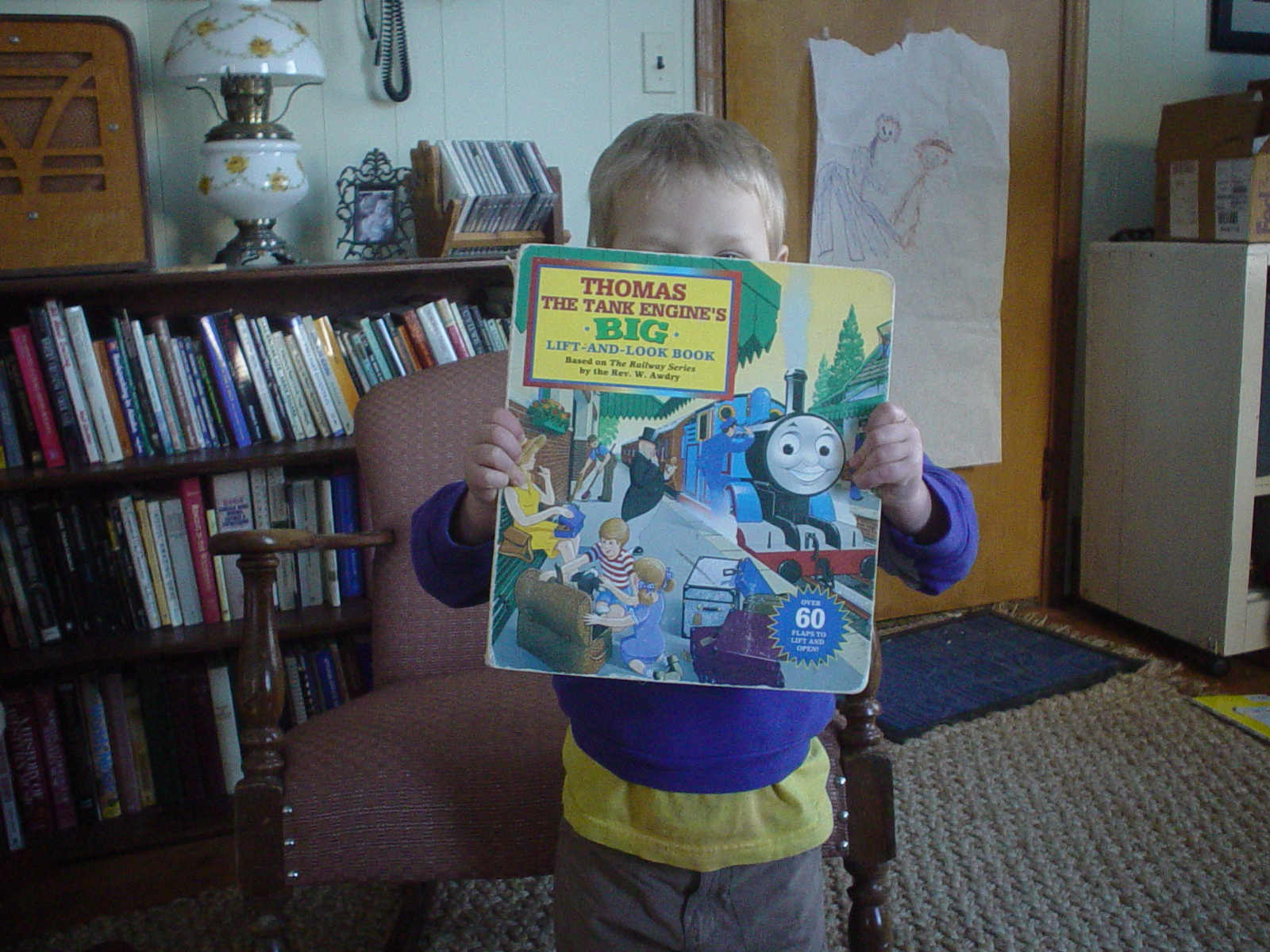
In February, the actual scene might look more like this: I am in a rocking chair, holding a book. It is not Plato’s Republic, but Thomas the Tank Engine’s Big Lift and Look Book. One child is on my lap because he was biting his sister at bedtime. The other is screaming that she is scared to be alone in her room. My drink of choice is Kahlua and cream, but I already drank it all. I didn’t bother putting the chocolate and ginger in a dish, but just ate them out of the bag while standing in front of the kitchen cupboard, keeping my back strategically turned towards the always-underfoot children. Dirty dishes are piled around the sink, and my husband is folding laundry on the couch. It’s looking like tomorrow’s dinner will once again be baked potatoes and carrot sticks. But at least I’ve got those jars of tasty ketchup that I canned in the summer.

For years now, I have regretted that Christmas is celebrated so early in the winter. Couldn’t people have waited until winter got good and nasty to have a big celebration? In December, even here in Minnesota, we can never be sure if we will even have snow for Christmas. In February, it’s a sure thing. In February, I am hungry for something to celebrate. I have become half-bear, convinced that hibernation would solve all my troubles. I, who love to get out of bed and go for a run at 5:00 on summer mornings, can hardly roll over by 8:00 on February mornings. I feel sleepy, swollen, and stupid; weary of the piles of clothes from which I must exhume myself every night for bed, weary of shoveling snow, weary of refereeing the ridiculous arguments and murderous brawls my small children have made their full-time occupation.

I know, the Christmas celebration lines up with the winter solstice, celebrating the return of the sun and longer days. And I do feel a glint of joy in February when I notice it is 5:00 and the sun is still shining. But, oh, how lovely it would be in February to saturate the house with the crooning of Nat King Cole, bake up a passel of Christmas cookies, fill up the calendar with parties and . . . the kids’ room with newly opened presents . . . and . . . hey, wait a minute, that sounds exhausting.

Skip it. The afternoon winter sun is radiating through the window, and I can just sit here and let it warm me, with no mental stress over cookies I’m not baking, parties I’m not planning, or even weeds I’m not pulling or gorgeous summer day I’m not taking full advantage of. I’ll bet there will be brilliant stars out tonight, with moonlight glowing over the snow. Alright, February, I surrender.