Reaching Maturity, or, If I Were a Tomato

On Monday evening my proud papa showed my youngsters video clips he had taken of me and my band almost ten years ago. There we are, up on the big stage, under the bright lights, playing our twenty-something hearts out. “We were young and we were improvin’. . .”
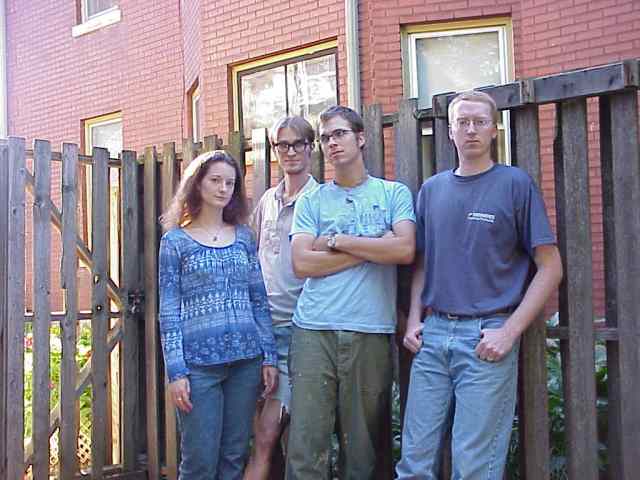
the glory days for rock band St. Andrew's Descent

the glory days for rock band St. Andrew’s Descent

Mellencamp was on to something, although I haven’t always thought so over the years. Wrinkles, gray hairs, extra pounds and stretch marks don’t seem like an improvement. But they are simply markers of the real life I’ve been living. The wrinkles around my eyes record the smiles and laughs that have crinkled the skin there again and again. The creases between my eyebrows show the grip of stress, grief, and anger. The gray hairs grow from a head that has pumped out thoughts and dreams at the pace of a Chinese toy factory. The poochy tummy and the stretch marks tell about the two people I co-created, nourished, carried and bore into the world.

These days I don’t look back as wistfully as I used to. I can almost laugh at – I mean with – no, I mean at – the profoundly serious girl up there on the stage, who scans every audience for a talent scout and will soon cry herself to sleep the night she learns of her first pregnancy, certain this means death to her creative life.

Small children, it turns out, are small for only two or three blinks of an eye. This is a great relief and an eternal sadness.
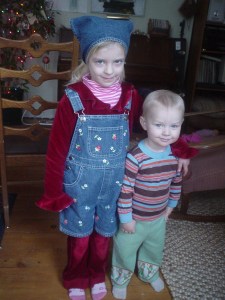
yes, they dress themselves!

yes, they dress themselves!

They are also loaded with material – not only the fecal variety, but the sort of material every writer seeks – magical moments, ironic situations, hilarious word usage, and heart-stabbing lovelinesses and tragedies of all sorts.

On Tuesday morning I took my guitar down from the wall and began to play and sing. My two-year-old Silas hurried from the other room, smiling and dancing like sun-sparkles on a forest stream. It was a stellar performance. I totally connected with the audience. I’m pretty sure I’ll get another call soon (“Mommy! Play my song again!”).

Lately I’ve discovered that the songs and performances I do create, when I take the time, are better than those of ten years ago, and they often take less effort. I think this is about reaching maturity.

This past spring I bundled up and went out to the garage, where I poked tiny tomato seeds into small pots of soil arranged on an old cookie sheet. I brought the cookie sheet into the house and set it on top of the refrigerator so the seeds could stay warm and germinate.  It took about a week before I saw more than soil in those pots. It took even longer for the tiny seedlings to grow into recognizable tomato plants that could stay outside overnight alone.

Once I finally got the plants outside, the tender leaves soaked up sunlight and used that energy to make more leaves, which all soaked up more sunlight and made more leaves, so that the plants grew exponentially. A couple weeks ago, green tomatoes began blushing into red, and I knew that the plants were doing what the seed packet had said they would do in the prescribed number of days – reaching maturity. Now every day I spot another brilliant red tomato, standing out vividly from the surrounding green leaves.

If I were a tomato plant, I think I would currently be putting out yellow blossoms. These blossoms are more interesting than the green leaves I have spent much of my life to produce, but it gets even better! If I keep growing, one day I will make brilliant red fruit with the power to nourish and cheer whoever finds it. I don’t miss those spindly seedling days. And I’m not seeking to preserve these yellow flowers. I’m going for the juicy red fruit. I’m reaching for maturity. I’m still young and still improving.

A Long Line, Redirected

Joanna and Jeremiah Kriebel, my great-great-grandparents

The headstone for my great-great-grandparents’ grave

Last month our family spent a week in and around Lansdale, Pennsylvania, visiting relatives in the land where my parents grew up. Nearby Philadelphia was the childhood home of my dad’s mother, whose own parents had come there from New York, and originally from Cuba (her father’s side) and Austria (her mother’s side). His father grew up an Ohio farm boy who joined the Navy young and moved his family around many times before settling near Lansdale when my dad was a small child.

My mother, however, was born in this area, as were her parents, her grandparents, her great-grandparents, and so on, back to the ancestor who arrived at the port of Philadelphia in 1734, on the ship St. Andrew, which carried German people known as Schwenkfelders seeking religious freedom.

While we were in Lansdale last month, my mother, my two children and I went to visit the Schwenkfelder Library and Heritage Center, where we connected more deeply with our roots and also knocked over a mannequin and climbed on things we weren’t supposed to (Mom and I did the connecting; Lu and Si did the knocking and climbing).

Afterwards, we stopped at the Towamencin Schwenkfelder Cemetery, which lies at the end of a short lane off a busy road which just happens to be Valley Forge Road, along which the Liberty Bell made an escape from Philadelphia to Allentown during the Revolutionary War.

The cemetery is surrounded by housing developments now, but at one time all that land was Vista Glen Farm, handed down the Schwenkfelder line from the 1700s until my mother’s grandparents, Harold and Ethel Kriebel, retired from farming and sold the land. When she was a small child, the age my daughter is now, my mom (a.k.a. “Little Becki” in the stories she tells my children) lived on that farm with her parents and older sister in one side of the farmhouse, and her grandparents in the other.

Luthien, Silas, and my mother, "Little Becki"

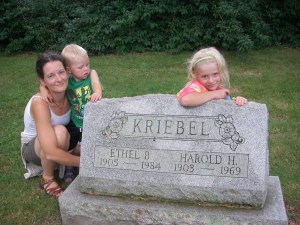
Luthien, Silas, and my mother, “Little Becki”

Here on this land, Little Becki played and explored. On the day we visited, grown-up Becki cried, flooded with memories as she stood in front of a row of gravestones resembling a series of books – the headstone of her grandparents, next to that of her great-grandparents, next to that of her great-great grandparents.

Her own mother, my grandmother Thelma, will probably not be buried here, because she made a choice that redirected the long line of German Schwenkfelder roots that she could trace back to the 1500s. Thelma married a Mennonite boy named Sam, who died when I was four and is now buried elsewhere. I imagine she wants to lie down next to him when it’s time. Until I stood in front of that headstone series, I hadn’t felt the significance of my grandmother’s redirection of the line.

There are six Schwenkfelder churches in the world, with roughly 3,000 members, and all are in southeastern Pennsylvania, where the Society of Schwenkfelders was formed in 1782. This is a long-held, short-ranged tradition. When Thelma married that Mennonite boy Sam, and together they joined the independent Baptist church, it forever altered the line. Now I, two generations removed, stand on the outside of the religious tradition of my forebears, looking in. Instead, I grew up an insider to the fundamentalist tradition towards which my grandparents turned the line, often wanting out.

Me, Silas and Luthien at my great-grandparents' gravestone, Towamencin Schwenkfelder Cemetery

Me, Silas and Luthien at my great-grandparents’ gravestone

But I would not exist at all had it not been for her love and life with Sam, or for their little Becki’s union with Larry, my father. And now, because I chose Nathan, the son of Steve who himself redirected a long line of Minnesota Swedish immigrants by marrying JoAnne, there are two beautiful people in the world named Luthien and Silas.

Lately I’m very interested in tracing these lines. I’ve started searching for more genealogy information not just for my family but also for Nathan’s, and I find it fascinating to learn about the people from whom my children are descended.

Just as fascinating, I expect, are the people who may yet live because of the straightaways, twists and turns these lines have yet to take. They are lines of genes, traditions, ideas, sins and good works. Passed down the generations, woven in every union, birthed in every child, they make a living, changing, collaborative work of art full of beauty and shame, glory, struggle, pain and pride.

These lines are only in our hands for a little while. May we hold – and redirect – them well. And thank God they can always be redirected, or held, further down the line.

Guest Post – It Happened in Iowa

My husband Nathan, our two children, and I are in the midst of a 19-day road trip, spending this week on Lake Michigan and heading on to Pennsylvania next week. We stopped at a motel after our first day of driving, and Nathan had a memorable interaction about which he spent the next morning writing on the laptop in the car.

I have been encouraging him to start a blog, but he said I could post this piece he wrote on my blog. So here it is. If you want to hear more from him, send him an e-mail (nathan@cabinoflove.com) and add your voice to mine in begging for a Nathan Bloom blog!

Here it is:

Last night, I was traveling with my family en route to our vacation destination in Michigan. We were driving through Iowa, the sun had set, and the kids were asleep, so Julia and I decided to put on some “easy miles” before stopping for the night.

Just after 11pm, we opted to call it a night and pulled into a Days Inn. As I walked into the hotel lobby, I noticed an elderly couple laboriously exiting a minivan. The receptionist was busy checking in another guest, and the three of us stood wearily in the lobby, waiting silently. The woman stood rigidly by the corner of the front desk, while the man wandered back into the empty lounge. As I waited, the thought occurred to me that it would be a courteous gesture to defer my ‘next-in-line’ status to this couple. Though my wife and children were waiting in the car, I made up my mind that when my turn came, I would let it pass to my elders.

The sleepy atmosphere was suddenly rent by a shockingly loud episode of flatulence coming from the lounge. My resolve wavered a little. After finishing checking in the guests ahead of us, the receptionist called out: “who’s next?” The woman at the corner of the desk glanced back. “Go ahead,” I offered. She immediately placed her enormous purse on the desk and commenced the check-in process.

The short, stoop-shouldered man ambled back from the lounge, and looked up at me. “Whererya from” he queried

“Minnesota”, I replied.

“Whereabouts?”

“Owatonna”

“Oh yeah. . . up on 169” he said.

“No, it’s on I35”

“Oh yeah” he returned vaguely. “I’m from Algona”

“Where are you headed?” I re-orientated the conversation.

“Chicago”, he sturdily responded. “We are going to a booksellers convention.” “A Christian bookseller’s convention,” he quickly clarified.

The woman quickly turned away from the desk and corrected somewhat severely: “It is a Craft Fair this time.” She included some more apparently important details which I didn’t comprehend, and I didn’t ask, not wanting to prolong the correction. She turned back to the receptionist.

“We belong to the Evangelical Free church,” the man volunteered unexpectedly, “What church do you belong to?”

I faltered, unprepared to answer: “The church I attend is not affiliated. . .uh, non-denominational, I guess. . . The church I grew up in was Baptist General Conference, though,” I added, trying to give him something meaningful within his presumed construct.

“Ah Yes,” he replied. “The fighting baptists.” I smiled, understanding his reference to the particularly schismatic history of baptist churches in the USA. “There was a big split in one of the baptist churches in Algona,” he added.

“Yeah,” I responded with detached amusement, “Jesus said: ‘One command I give you- Love one another’, but it seems like that is always the first thing to go out the window!”

The woman suddenly turned back around, and with the austere gaze of a fundamentalist Sunday School teacher, demanded: “But what was his other commandment?”

I fumbled, trying not to be intimidated, mentally re-scanning my words, and Jesus’ words, desperately trying to remember what the second of the one commandment was.

With trepidation, I held my ground: “He said one command.”

“Ye must be born again” She said sharply. “That is the greatest commandment. You can love all you want, but it won’t do you any good!” She continued her stern gaze, and I held my tongue.

She turned back, finished her check-in, and the two left to go to their rooms (I now understand why they had gotten two.)

Confessions of a worship leader

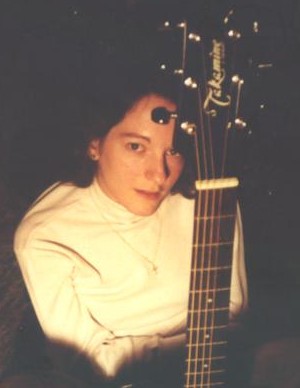
juliatakaminecroppedI wrote this a couple weeks ago and almost didn’t post it – because I realized I am SO out of touch with trends in worship music that I may be criticizing a relic of the past rather than the present situation. I changed the channel for my sources of church music roughly seven years ago. Here’s the post – what do you think (besides the fact that it’s awfully long!)? How have things changed or stayed the same in recent years?

May I confess something? Lean in while I glance around and try to be discreet. Okay . . . I do not enjoy worship music. I also don’t listen to Christian radio or have much familiarity with the latest and greatest contemporary Christian music, or praise songs, or whatever the hip terminology is these days.

I could say much about what I find to be the often uninteresting, generally poor quality of the music itself, while freely admitting the same could be said about much of the music I write. Interesting music doesn’t just grow on trees (or radio airwaves, Christian or otherwise). I’m sure there is well-done music on Christian radio stations, but frankly I’ve grown tired of listening through so much else just to hear something worthwhile now and then.

The God described in the lyrics for much of this music isn’t someone I feel inspired to worship. Date or marry, maybe – he sure sounds like a fantastic boyfriend in the sky (strong and sensitive and always there for me!) – but I feel cheap and plastic when I attempt to worship the Creator of the Universe by singing songs that could just as easily work by replacing “Jesus” with “baby.”

Don’t get me wrong – I do not wish to categorically denounce modern church music. I grew up in churches singing only hymns accompanied by piano and organ and a man (always a man) up front waving his arms like a conductor. Until I learned to read and got to hold the hymnal, I wondered what a “pyonder” was, because no one I knew said anything remotely like “when the roll is called up yonder” anywhere besides in church.

Occasionally we sang well-written hymns, like “What Wondrous Love” (that haunting melody and ageless lyrics from Walker’s Southern Harmony), “This is My Father’s World,” “Holy, Holy, Holy,” and anything by Isaac Watts. But page through any hymnal and you’ll discover reams of oldies-and-not-so-goodies.

Many of the old hymns that nobody feels like singing anymore were popular in their day. Some of them were set to corny music that was only trendy for a few years, and that’s why we don’t sing them anymore. While music can be changed if the words warrant singing again, many of these songs employed images that were powerful for the writer’s contemporaries but can’t connect across the ages. “Onward, Christian Soldiers” and “Hold the Fort, for I am Coming” are two examples of hymns using war imagery in a time when wars and soldiers were highly idealized, before Vietnam produced a cultural shift in perspective about war (i suppose September 11th produced a pendulum-swing cultural shift, but that’s another conversation).

Maybe today’s preoccupation with God as the ultimate boyfriend is a reflection of our oversexed, Disney-princess-ized culture. Many of the songs we sing these days are written from an individual perspective (“I” the believer in Christ, not “we” the body of Christ), and describe that individual as a weak and helpless person who needs nothing else but God, strong and loving, who will rescue her from evil, hold her gently, love her forever, and one day take her home to his castle in the air (Heaven).

These aren’t necessarily wrong ideas, though I would argue against the “going away to Heaven” idea vs. Heaven coming to earth and healing it (see N.T. Wright’s Surprised by Hope), but pounding away on this one metaphor again and again, we lose perspective. Our God – and we humans – and the relationship between us – are more complex than that. There’s simply a lot more we could say when we sing about God, including some of my personal favorites: justice, the kingdom of God, and resurrection.

Some of the ultimate-boyfriend love songs are well-written, and I actually like and use them. I just don’t like singing more than one or two of them at a time.

There are fantastic songs, old and new, that can help us step out of our romance-novel mold. Some of my favorite newer ones are “He Reigns” by Steve Taylor, “Faithful” by David Ruis, and “Lutheran Hymn” by Michael Roe (the latter two are not popular but worth finding). And I’ll bet there are many more.

Because I am familiar with so many hymns, and because they’re public domain, and also because they connect us with our roots and the larger century-spanning community of faith, I have begun incorporating more of my favorites into the worship services I lead. It’s harder to keep up with, and access on a limited budget, newer songs.

So I’ll end my confession with a petition: does anyone have suggestions for places to look, or songs you enjoy that break out of the love-song mold? And what other comments do you have? I’m all ears now that I’ve used so many words!

Exactly Luthien

Luthien took this photo of herself last summer

Luthien took this photo of herself last summer

My girl is extreme, expressive, exhausting, exciting, exasperating, exuberant, extraordinary. Every moment, to her, is a canvas waiting for color; a page waiting for poetry; a reel of tape waiting for a symphony.

Each day she leaves a trail of artifacts marking the twisting turning path of her imagination. At the foot of her bed, hastily-discarded pajamas and underwear. A few steps away near the dresser and closet, a shallow sea of rejected wardrobe ideas. Scattered over the living room floor, a stuffed dog with a rope tied around its neck (its leash), surrounded by wooden blocks (its food); rubberbands and wadded-up, tape-wrapped newspaper balls (her bow and arrows); a stool pushed up against the window (to close the curtains because she’s camping and it’s nighttime); the piano bench pushed up near the bird cage (to let the bird out); paper and markers spread out on the table (where she was making storyboards for the movie she wants to direct); a small pile of awkwardly-folded laundry (where she was briefly in the mood to help with the housework); library books scattered around a throw pillow (she is working on learning to read); a few dolls wrapped up in blankets and napping on the couch.

In the bathroom, an open bottle of essential oil, a tube of lip balm knocked over in her haste to flee the scene of the crime when she heard the owner of these items approaching. In the kitchen, a stepstool pushed up to the counter, a cabinet left open, exposing a raided snack cupboard. In the back yard, a bowl of walnuts picked up from the yard, crushed and mixed with water (homemade perfume); a small boulder on the patio (where she enlisted a friend’s help to drag it so she could crush said walnuts); a wagon tied to a bicycle with a jumprope (car and trailer); a table spread with cups, a pitcher of water, and eight little metal bowls filled with raisins (a snack stand for the neighbors); a pair of sandals in the driveway; a beach towel wadded up under the walnut tree; ponytail holders and barrettes discarded on the picnic table.

Washing hands in a public restroom involves at least three squirts of soap from the dispenser, a roaring cascade of water from the sink, and as many paper towels as she can get her hands on before she is interrupted by a reprimand or a more interesting distraction.

This is my girl, unlike any other. Dancer, scholar, beauty, artist, lover, fighter, cook, bicyclist, inventor, problem-solver, preacher, scientist, singer, fairy, dreamer. And then some. She thrills me, annoys me, inspires me, exhausts me, entertains me, loves me, ignores me, kisses me, confuses me. She expands my horizons, reminding me of what I already knew – that this world is bigger than me – and surprising me with the hardly-believable truth that this world is also bigger than her – as she pushes ever forward with every fiber of her hard-headed wild-hearted starry-eyed iron-willed being.

My lover and I had a dream once, to sail the world together. On the brink of turning the dream to reality, we discovered this girl would be expanding our family. I thought we traded our dream of sailing the world for the mundane experience of parenting, but Luthien has proved me wrong. We are right on course, exploring new territory, fighting stormy gales, sleeping under the stars, going stir-crazy in confined spaces, and learning to lay aside our schedules and expectations to work with the unpredictable wind that pushes and pummels the colorful sail we named Luthien.