A Long Walk, A Thousand Miles From Newtown

On Saturday Silas and I walked downtown to buy a book for his kindergarten class gift exchange.

On Friday our town had been a snow-covered Christmas-fairy-tale village. Then it rained. It rained on Friday night, and all day Saturday. The rain erased the snow and exposed the husks and straw of fall to the numb gray sky.

We bought our book and headed home through the mist. Everything was crying. We moved slowly and silently, my 37-year-old legs newly attuned to his six-year-old pace.

The cheerful Christmas music piped through Central Park’s loudspeakers sounded alien and anachronistic.

We passed the post office and the library, who face one another across Broadway. Their flags waved wearily where they had fallen, halfway to the muddy ground.

We passed my children’s school, whose flag also trailed low, heavy with its load of grief.

We passed three neighbor boys on bicycles. I smiled and said hello. They were painfully beautiful.

That was a very long walk. I am still tired from it.

Matryoshka Doll

Here’s a poem I wrote last year, about my multilayered identity of recovering good girl, wife, mother, and aspiring artist.

Matryoshka Doll

When they drop by the house
I am in my apron in the kitchen.
In their eyes I see a glimmer of worship
At sighting a domestic angel.
My young son is building superstructures in the living room
And I am baking bread
So I am a stay-at-home mom
(Apparently).

Once, remarking on my unpainted face,
Someone asked for counsel
About wifely submission.

They find me writing at the coffee shop
And praise my husband for giving me time off
From what (apparently) is my real work.

A little girl within
Believes them
Craves their favor.

A woman deeper still
Knows more
Feels lonely feisty misunderstood
Amused
Angry stuck sad useless.

At her heart is a human
Being
Living
Gestating
Faith hope love.

The heart of her heart
Throbs with the secret
And the strength
Of labor
The grip of death
That releases life
And, once more,
She breathes.

Random Thoughts on a Touchy Topic

When I was young, I knew with certainty that abortion was wrong. It was a black-and-white issue. A baby is a baby is a baby. Life begins at conception, and abortion stops a beating heart. Abortion is murder. I couldn’t understand how anyone could see things otherwise. I was sure that anyone with a different opinion was godless and heartless.

In my young adulthood, I met a young man who was also an evangelical-striped Christian. But he voted Democrat and identified himself as pro-choice. He explained that even if abortion was a moral wrong, he didn’t think it was right for a mostly-male Congress to be making laws governing women’s choices about what was going on inside their own bodies.

My thought-evolution on this issue has continued. Currently, I would say that I am undecided.

Here is a random list of thoughts and things I have learned related to this issue. These are not points or arguments. Please don’t read them as such. I am thinking out loud:

Planned Parenthood is mostly about providing low-cost or free health care to women. I was always taught that this organization was pretty much pure evil, so even today when I know better, just the name “Planned Parenthood” still elicits a visceral negative reaction for me.

Medical technology has advanced so that surgery can be performed on babies in the womb, and babies can survive birth at earlier stages of development than ever.

The phrase “every child a wanted child” rings a little hollow to me. It has been used as a pro-choice argument that no child should be born to a mother who doesn’t want him or her. I agree with this sentiment, but I think a better solution is to build a world where people welcome and support children (and by extension, pregnant women and mothers of young children), not where unwanted children are denied existence.

I find the ideas on Feminists for Life‘s website intriguing, especially their FAQ answer regarding criminalizing abortion (though it seems a bit evasive).

Adoption is often held up as an alternative to abortion. But carrying a pregnancy to term is a major life disruptor in and of itself, especially if a woman already has young children (and most women who get abortions are already mothers of previously-birthed children).

It is possible to hold a pro-choice position concerning legislation and a pro-life position concerning morality. I suppose this would be a libertarian position, similar to positions on other issues such as drug use, alcohol consumption, sex, and religious beliefs.

This is a controversial issue for good reasons. The entire journey that an egg and a sperm make to become a newborn baby happens inside a woman’s body. Is it really good policy to dictate to her what she does about that activity going on inside of her? If we can make laws about whether women may terminate their pregnancies or not, can we also make laws about how they will treat the growing child inside their body? Can we make it illegal for pregnant women to smoke or drink?

Why are so many “pro-life” people also outspoken critics of welfare in any form? If you want to reduce abortions, wouldn’t you want to help build a world where children are cared for, no matter their household income – and where women have access to contraception to prevent pregnancy in the first place? But I understand that many people who are opposed to government-sponsored welfare think that churches and community groups should be the ones providing poverty relief. And that’s another non-black-and-white issue for another day . . .

According to recent demographic research, poverty – and the inadequate health care and lack of access to contraception that goes along with it – is a significant contributor to the choice to abort a pregnancy. This blog post and video discusses this information more.

Referring to his daughters, President Obama once said, “I am going to teach them first of all about values and morals. But if they make a mistake, I don’t want them punished with a baby.” Unfortunate choice of words, I’d say. Whatever he meant by that, I think it reflects the reality of our patriarchal society which marginalizes women and even more so marginalizes children (and the elderly, mentally/physically challenged, etc.) and the people – often women – who care for them. Once again, this raises for me the reminder that abortion must be understood in its larger context of social and systemic issues that de-value people who don’t “keep up” with the expected pace of American life – 16+ years of formal education, 40+weekly hours working a “real job,” etc.

That’s a long enough list for now.

Abortion, like life, is not a black-and-white issue. I’m weary of both pro-lifers and pro-choicers ignoring the complexities involved  (though of course not everyone from either perspective does so).

These are just some opening thoughts to a conversation I hope we can have here. Let’s talk. What do you think? Or feel? Or wonder? Or what have you experienced? Or learned? Or considered? I’m looking for a thoughtful and respectful conversation about an often-heated topic. So it may be a good idea to read your comment over one extra time before you make that final click.

*Update: Recently I heard this OnBeing podcast  with David Gushee and Frances Kissling about abortion. I highly recommend it as a model of thoughtful conversation on this issue.

Peace to the People

When the Occupy Wall Street movement began over two months ago, I just wasn’t interested. The national political scene mostly tires and annoys me, so I don’t pay much attention.

Then there was the UC-Davis pepper spray incident, apparently not the first of the pepper-spray incidents. How about an 84-year-old woman? But I digress.

There they sat, quiet and stubborn college students; and there they stood, riot-geared tough-faced police.

I don’t know or understand the whole story. I know police work is difficult and complicated. But a scene like this leaves me cold, wondering what in the world we have come to. So do the vicious comments people scream at one another in the cyberspace around such videos.

Contemplating the scene after watching it the first time (and having a good little cry), I saw children all around. Idealistic and strong-willed children sitting on the ground. Threatened and insecure children strutting in their sunglasses and holsters. Simplistically-indignant children shouting “Shame on you!” at the bullies.

But no one stepping out of their pigeonhole. It probably wasn’t the time or place, but it seems we have less and less times and places for people to un-dig their heels and speak with kindness, patience, and genuine interest to one another across ideological lines. (A stream of pepper spray sort-of discourages such things too.)

Most of us have learned from childhood that we must fight to win. Of course, not at home with your sister (“share your toys!”). But in the movies and the storybooks, and definitely in the adult world – we have learned that you can’t prosper if you don’t beat down the bad guys. The good guys win. Not everybody. Only the good guys.

Republicans and Democrats, Tea Partiers and Occupiers, and many of us watching from our comfortable armchairs, are too often colorblind. We can only see ourselves and each other and the world at large in black and white. We line up people and ideas on “good” and “bad” sides, and then we start shooting – or spraying, or shouting. And we miss the depth of colors, the beauty, truth and goodness mingled with selfishness and brokenness in life at every level.

This is not to say we don’t form opinions and speak out for them. Personally, I am glad the Occupixies are doing their thing, and I much prefer this movement to the Democrats and Republicans (and philosophically I prefer it to the Tea Party, but I admire the grass-rootsiness of the TP too). But ultimately, we’re all a little lost, aren’t we? And it probably wouldn’t make things any worse if we practiced more patience and peace, listening and learning.

As I contemplate the UC-Davis pepper-spray scene – from my comfortable armchair – it’s easy to spout grand ideals about peace and love. But in the heat of showdown moments in my own life, I have stood (or sat) in each of those positions. I have sprayed and been sprayed, and I’ve shouted at bullies too. Sometimes, we become so passionate about our ideals or enraged about injustice, or even threatened and impatient, that we do dig in our heels or lash out at others; and I’m not suggesting that we can or even should keep such things from happening at all costs. History has taught us that “good guys,” eager to stop evil on every front, can all too quickly become “bad guys” in their very acts of fighting evil.

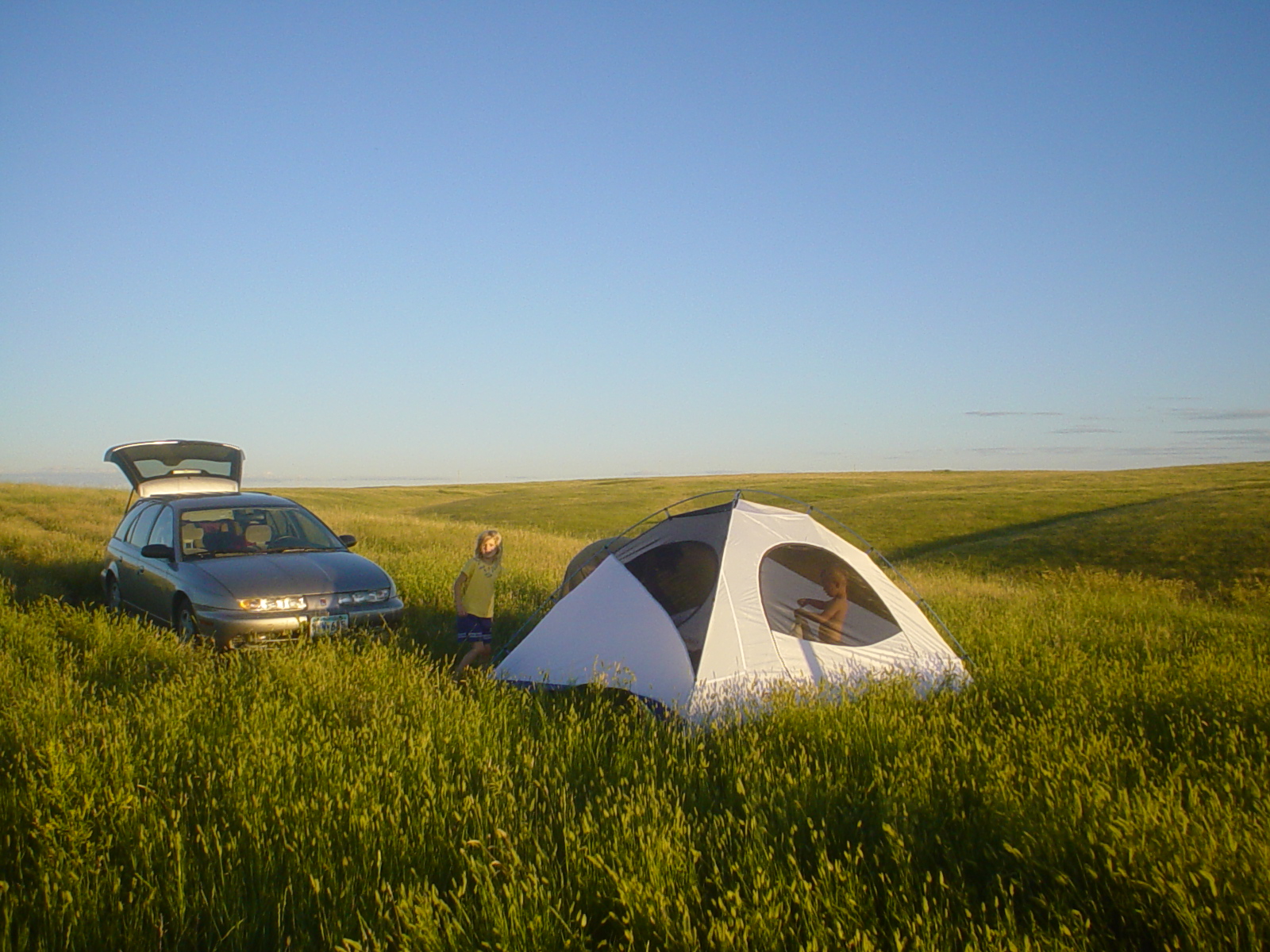
Occupy Fort Pierre National Grassland! - a day in our peaceful parenting protest

In discussing environmental and agricultural concerns, Wendell Berry called gardening a “complete action,” because it is not only a symbolic protest but also an actively-implemented solution to the problem it protests. Though I won’t be joining any tent cities, I have realized that I can launch my own protest just as effectively right where I am. I think maybe peaceful parenting, like gardening, is a complete action, and in watching the Occupillars, I am inspired to keep at it.

Today, my family and I look together for the good in each person. Today, we practice love and respect with one another. Today, also, I scream at my children and they push and punch one another. We’re good and bad, and everything in between, but we continue to get back up, apologize, and start over again.

Peace begins at home. But it doesn’t have to end there.