Reaching Maturity, or, If I Were a Tomato

On Monday evening my proud papa showed my youngsters video clips he had taken of me and my band almost ten years ago. There we are, up on the big stage, under the bright lights, playing our twenty-something hearts out. “We were young and we were improvin’. . .”
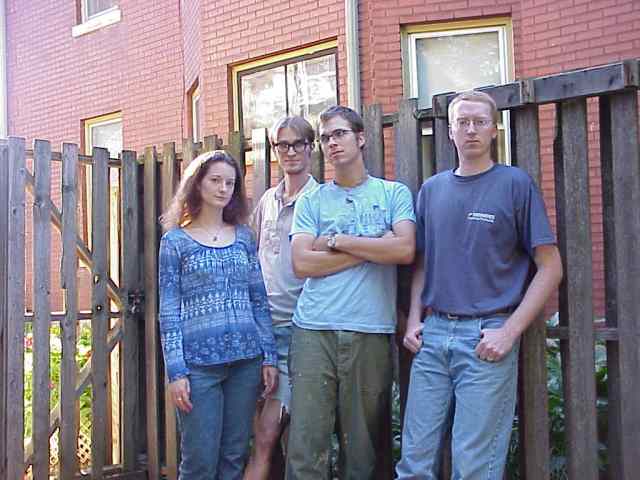
the glory days for rock band St. Andrew's Descent

the glory days for rock band St. Andrew’s Descent

Mellencamp was on to something, although I haven’t always thought so over the years. Wrinkles, gray hairs, extra pounds and stretch marks don’t seem like an improvement. But they are simply markers of the real life I’ve been living. The wrinkles around my eyes record the smiles and laughs that have crinkled the skin there again and again. The creases between my eyebrows show the grip of stress, grief, and anger. The gray hairs grow from a head that has pumped out thoughts and dreams at the pace of a Chinese toy factory. The poochy tummy and the stretch marks tell about the two people I co-created, nourished, carried and bore into the world.

These days I don’t look back as wistfully as I used to. I can almost laugh at – I mean with – no, I mean at – the profoundly serious girl up there on the stage, who scans every audience for a talent scout and will soon cry herself to sleep the night she learns of her first pregnancy, certain this means death to her creative life.

Small children, it turns out, are small for only two or three blinks of an eye. This is a great relief and an eternal sadness.
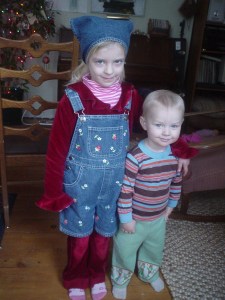
yes, they dress themselves!

yes, they dress themselves!

They are also loaded with material – not only the fecal variety, but the sort of material every writer seeks – magical moments, ironic situations, hilarious word usage, and heart-stabbing lovelinesses and tragedies of all sorts.

On Tuesday morning I took my guitar down from the wall and began to play and sing. My two-year-old Silas hurried from the other room, smiling and dancing like sun-sparkles on a forest stream. It was a stellar performance. I totally connected with the audience. I’m pretty sure I’ll get another call soon (“Mommy! Play my song again!”).

Lately I’ve discovered that the songs and performances I do create, when I take the time, are better than those of ten years ago, and they often take less effort. I think this is about reaching maturity.

This past spring I bundled up and went out to the garage, where I poked tiny tomato seeds into small pots of soil arranged on an old cookie sheet. I brought the cookie sheet into the house and set it on top of the refrigerator so the seeds could stay warm and germinate.  It took about a week before I saw more than soil in those pots. It took even longer for the tiny seedlings to grow into recognizable tomato plants that could stay outside overnight alone.

Once I finally got the plants outside, the tender leaves soaked up sunlight and used that energy to make more leaves, which all soaked up more sunlight and made more leaves, so that the plants grew exponentially. A couple weeks ago, green tomatoes began blushing into red, and I knew that the plants were doing what the seed packet had said they would do in the prescribed number of days – reaching maturity. Now every day I spot another brilliant red tomato, standing out vividly from the surrounding green leaves.

If I were a tomato plant, I think I would currently be putting out yellow blossoms. These blossoms are more interesting than the green leaves I have spent much of my life to produce, but it gets even better! If I keep growing, one day I will make brilliant red fruit with the power to nourish and cheer whoever finds it. I don’t miss those spindly seedling days. And I’m not seeking to preserve these yellow flowers. I’m going for the juicy red fruit. I’m reaching for maturity. I’m still young and still improving.

A Long Line, Redirected

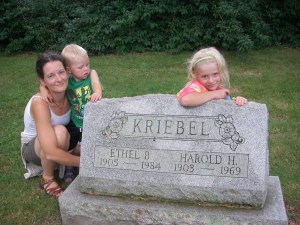
Joanna and Jeremiah Kriebel, my great-great-grandparents

The headstone for my great-great-grandparents’ grave

Last month our family spent a week in and around Lansdale, Pennsylvania, visiting relatives in the land where my parents grew up. Nearby Philadelphia was the childhood home of my dad’s mother, whose own parents had come there from New York, and originally from Cuba (her father’s side) and Austria (her mother’s side). His father grew up an Ohio farm boy who joined the Navy young and moved his family around many times before settling near Lansdale when my dad was a small child.

My mother, however, was born in this area, as were her parents, her grandparents, her great-grandparents, and so on, back to the ancestor who arrived at the port of Philadelphia in 1734, on the ship St. Andrew, which carried German people known as Schwenkfelders seeking religious freedom.

While we were in Lansdale last month, my mother, my two children and I went to visit the Schwenkfelder Library and Heritage Center, where we connected more deeply with our roots and also knocked over a mannequin and climbed on things we weren’t supposed to (Mom and I did the connecting; Lu and Si did the knocking and climbing).

Afterwards, we stopped at the Towamencin Schwenkfelder Cemetery, which lies at the end of a short lane off a busy road which just happens to be Valley Forge Road, along which the Liberty Bell made an escape from Philadelphia to Allentown during the Revolutionary War.

The cemetery is surrounded by housing developments now, but at one time all that land was Vista Glen Farm, handed down the Schwenkfelder line from the 1700s until my mother’s grandparents, Harold and Ethel Kriebel, retired from farming and sold the land. When she was a small child, the age my daughter is now, my mom (a.k.a. “Little Becki” in the stories she tells my children) lived on that farm with her parents and older sister in one side of the farmhouse, and her grandparents in the other.

Luthien, Silas, and my mother, "Little Becki"

Luthien, Silas, and my mother, “Little Becki”

Here on this land, Little Becki played and explored. On the day we visited, grown-up Becki cried, flooded with memories as she stood in front of a row of gravestones resembling a series of books – the headstone of her grandparents, next to that of her great-grandparents, next to that of her great-great grandparents.

Her own mother, my grandmother Thelma, will probably not be buried here, because she made a choice that redirected the long line of German Schwenkfelder roots that she could trace back to the 1500s. Thelma married a Mennonite boy named Sam, who died when I was four and is now buried elsewhere. I imagine she wants to lie down next to him when it’s time. Until I stood in front of that headstone series, I hadn’t felt the significance of my grandmother’s redirection of the line.

There are six Schwenkfelder churches in the world, with roughly 3,000 members, and all are in southeastern Pennsylvania, where the Society of Schwenkfelders was formed in 1782. This is a long-held, short-ranged tradition. When Thelma married that Mennonite boy Sam, and together they joined the independent Baptist church, it forever altered the line. Now I, two generations removed, stand on the outside of the religious tradition of my forebears, looking in. Instead, I grew up an insider to the fundamentalist tradition towards which my grandparents turned the line, often wanting out.

Me, Silas and Luthien at my great-grandparents' gravestone, Towamencin Schwenkfelder Cemetery

Me, Silas and Luthien at my great-grandparents’ gravestone

But I would not exist at all had it not been for her love and life with Sam, or for their little Becki’s union with Larry, my father. And now, because I chose Nathan, the son of Steve who himself redirected a long line of Minnesota Swedish immigrants by marrying JoAnne, there are two beautiful people in the world named Luthien and Silas.

Lately I’m very interested in tracing these lines. I’ve started searching for more genealogy information not just for my family but also for Nathan’s, and I find it fascinating to learn about the people from whom my children are descended.

Just as fascinating, I expect, are the people who may yet live because of the straightaways, twists and turns these lines have yet to take. They are lines of genes, traditions, ideas, sins and good works. Passed down the generations, woven in every union, birthed in every child, they make a living, changing, collaborative work of art full of beauty and shame, glory, struggle, pain and pride.

These lines are only in our hands for a little while. May we hold – and redirect – them well. And thank God they can always be redirected, or held, further down the line.

Exactly Luthien

Luthien took this photo of herself last summer

Luthien took this photo of herself last summer

My girl is extreme, expressive, exhausting, exciting, exasperating, exuberant, extraordinary. Every moment, to her, is a canvas waiting for color; a page waiting for poetry; a reel of tape waiting for a symphony.

Each day she leaves a trail of artifacts marking the twisting turning path of her imagination. At the foot of her bed, hastily-discarded pajamas and underwear. A few steps away near the dresser and closet, a shallow sea of rejected wardrobe ideas. Scattered over the living room floor, a stuffed dog with a rope tied around its neck (its leash), surrounded by wooden blocks (its food); rubberbands and wadded-up, tape-wrapped newspaper balls (her bow and arrows); a stool pushed up against the window (to close the curtains because she’s camping and it’s nighttime); the piano bench pushed up near the bird cage (to let the bird out); paper and markers spread out on the table (where she was making storyboards for the movie she wants to direct); a small pile of awkwardly-folded laundry (where she was briefly in the mood to help with the housework); library books scattered around a throw pillow (she is working on learning to read); a few dolls wrapped up in blankets and napping on the couch.

In the bathroom, an open bottle of essential oil, a tube of lip balm knocked over in her haste to flee the scene of the crime when she heard the owner of these items approaching. In the kitchen, a stepstool pushed up to the counter, a cabinet left open, exposing a raided snack cupboard. In the back yard, a bowl of walnuts picked up from the yard, crushed and mixed with water (homemade perfume); a small boulder on the patio (where she enlisted a friend’s help to drag it so she could crush said walnuts); a wagon tied to a bicycle with a jumprope (car and trailer); a table spread with cups, a pitcher of water, and eight little metal bowls filled with raisins (a snack stand for the neighbors); a pair of sandals in the driveway; a beach towel wadded up under the walnut tree; ponytail holders and barrettes discarded on the picnic table.

Washing hands in a public restroom involves at least three squirts of soap from the dispenser, a roaring cascade of water from the sink, and as many paper towels as she can get her hands on before she is interrupted by a reprimand or a more interesting distraction.

This is my girl, unlike any other. Dancer, scholar, beauty, artist, lover, fighter, cook, bicyclist, inventor, problem-solver, preacher, scientist, singer, fairy, dreamer. And then some. She thrills me, annoys me, inspires me, exhausts me, entertains me, loves me, ignores me, kisses me, confuses me. She expands my horizons, reminding me of what I already knew – that this world is bigger than me – and surprising me with the hardly-believable truth that this world is also bigger than her – as she pushes ever forward with every fiber of her hard-headed wild-hearted starry-eyed iron-willed being.

My lover and I had a dream once, to sail the world together. On the brink of turning the dream to reality, we discovered this girl would be expanding our family. I thought we traded our dream of sailing the world for the mundane experience of parenting, but Luthien has proved me wrong. We are right on course, exploring new territory, fighting stormy gales, sleeping under the stars, going stir-crazy in confined spaces, and learning to lay aside our schedules and expectations to work with the unpredictable wind that pushes and pummels the colorful sail we named Luthien.

Good Girl, Humanized

I’m a pastor’s kid, AND . . . (I learned about the power of ‘and’ from my friend Cindy, who recently said labels too often keep us stuck. She said, for example, that although she is often impatient, she likes to say it like this – “I am impatient, AND I am learning to wait”).

So, I’m a pastor’s kid, AND I am learning to live boldly in spite of people’s opinions of me.

I was born to a Bible college student, and my younger brother was born to a seminarian. Our mother was a Bible college student’s wife, and then a seminarian’s wife, AND . . . although she wasn’t much encouraged to imagine the other side of the AND.

Officially I became a pastor’s kid (PK) when I was four and we moved to a tiny town in Rhode Island where my father became the pastor of a proportionally tiny church just about as old as America, with real steeple bells that the big boys got to ring every Sunday morning.

Two memories of our time at that church stand out to me. One morning, sitting in the front row with my mother and brother and a friend, I entertained myself and my friend during my father’s sermon by copying his gestures (with a bit of extra animation). Another Sunday, as my mother stood and sang in the choir, my three-year-old brother, terrified by a spider crawling on the pew beside him, ran to her and jumped in her arms.

After each of those services, I and my brother were respectively reprimanded for our antics. It may not have been spoken, but somehow we got the message that everyone was watching us, that we must behave well and not reflect poorly on our family.

It’s a lesson I learned early and well. Pastors’ kids, as people have over-generalized, are either angels or demons. I, proving the generalization, was a good girl in every way imaginable. Stepping into any new place when I was a child, my first concern was what the rules were, to make sure I kept them. As I grew into adolescence, so did the good girl. She was smart but quiet, pretty but safe in her always-modest dresses, passionate but only daring to hint at those passions through her handy talents of singing and writing.

Over the years my father went on his own journey of self-discovery and admitted that pastoring was something his mother had pushed on him more than he had desired. For a while I was a Bible college professor’s kid, at other times a salesman’s kid, a freelance writer’s kid, an unemployed man’s kid.

This past year I once again became a pastor’s kid, now with kids of my own. I’ve moved a long way from the good girl of my youth, not to rebel daughter, but to more confident, willingly weak, hungry, less-afraid, question-asking human. Very human. Repenting of the “we-they” “saved-lost” country club mentality from which I have operated most of my life growing up a pastor’s kid in church. The suitable-for-framing theology of my youth now looks to me just about as quaint and useless as my senior pictures.

This pastor’s kid wears shorts, drinks alcohol, plays rock music, goes to movies, and often votes Democrat. She also leads worship music in local churches, and regularly prays and reads her Bible. And she’s learned that abstaining from or exercising any of these things is a poor indicator of anyone’s faith.

The pastor whose kid I am has also changed. Now, when we meet on a Sunday evening after a morning when he was preaching and I was lounging in the back yard with my family and a cup of coffee, we smile and hug and talk about the past week, and the thought of what people might be thinking is as far away and irrelevant as the choir robe my mother wore that Sunday in Rhode Island.

Surprised by Jack

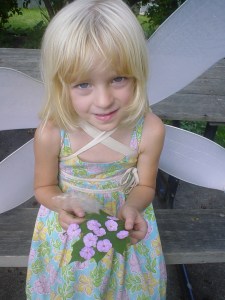
fairy luI live in a fairy forest. It’s a minuscule woodland, and I am its caretaker, while my five-year-old Luthien fancies herself its fairy princess.

As the keeper of the itsy-bitsy forest (comprised of three towering evergreens and the woodsy floor beneath them in my front yard), I have been busy planting shrubs and perennials purported to enjoy such a shady, piny spot. I’ve also, of course, been occupied with pulling up weeds to make space for those plants and manage the appearance of my garden-forest.

My gardening style is a bit wilder than the wood-chip-mulched norm. I rarely rake the pine needles or remove pinecones, and to remove weeds, I use my hands rather than a spray bottle. My definition of weeds is rather loose. The clover and the violets and the purple-blooming creeping Charlie, even the dandelions and the plantain are all possible keepers in my gardens, depending on their placement. It’s like sculpting – in one place, that dandelion needs to go, but somewhere else, it fits just right.

This morning while the kids perched on the neighbors’ steps to watch some city employees trim trees on the boulevard, I sculpted (i.e. weeded) my forest gardens. And to my delight, I discovered a new Jack-in-the-pulpit volunteer! It’s the third one I’ve found in the gardens, none of which I planted. I’ve also discovered catnip and milkweed volunteering in ideal spots in my gardens, and this spring a shrub I had left alone the last couple years, not sure what it was or where it had come from, opened for the first time into delicate white blossoms, revealing itself to be a honeysuckle.

Had I been overly ambitious to eradicate weeds and mulch thoroughly, I wouldn’t enjoy such surprises. While I am happily the keeper of the fairy forest, I recognize it lives and breathes and produces beauty with or without me; and it’s a joy to work with it rather than reign over it.

So bring on the Jacks. May their tribe increase. And I’ll be happy to kneel in my gardens, take my time pulling weeds here and there, and enjoy those moments revelling in the wild beauty of my fairy forest.