Confessions of a worship leader

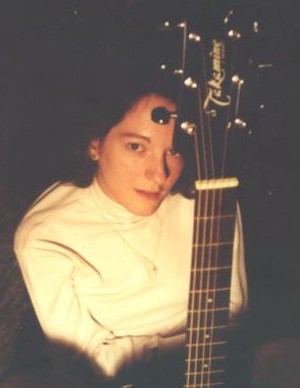
juliatakaminecroppedI wrote this a couple weeks ago and almost didn’t post it – because I realized I am SO out of touch with trends in worship music that I may be criticizing a relic of the past rather than the present situation. I changed the channel for my sources of church music roughly seven years ago. Here’s the post – what do you think (besides the fact that it’s awfully long!)? How have things changed or stayed the same in recent years?

May I confess something? Lean in while I glance around and try to be discreet. Okay . . . I do not enjoy worship music. I also don’t listen to Christian radio or have much familiarity with the latest and greatest contemporary Christian music, or praise songs, or whatever the hip terminology is these days.

I could say much about what I find to be the often uninteresting, generally poor quality of the music itself, while freely admitting the same could be said about much of the music I write. Interesting music doesn’t just grow on trees (or radio airwaves, Christian or otherwise). I’m sure there is well-done music on Christian radio stations, but frankly I’ve grown tired of listening through so much else just to hear something worthwhile now and then.

The God described in the lyrics for much of this music isn’t someone I feel inspired to worship. Date or marry, maybe – he sure sounds like a fantastic boyfriend in the sky (strong and sensitive and always there for me!) – but I feel cheap and plastic when I attempt to worship the Creator of the Universe by singing songs that could just as easily work by replacing “Jesus” with “baby.”

Don’t get me wrong – I do not wish to categorically denounce modern church music. I grew up in churches singing only hymns accompanied by piano and organ and a man (always a man) up front waving his arms like a conductor. Until I learned to read and got to hold the hymnal, I wondered what a “pyonder” was, because no one I knew said anything remotely like “when the roll is called up yonder” anywhere besides in church.

Occasionally we sang well-written hymns, like “What Wondrous Love” (that haunting melody and ageless lyrics from Walker’s Southern Harmony), “This is My Father’s World,” “Holy, Holy, Holy,” and anything by Isaac Watts. But page through any hymnal and you’ll discover reams of oldies-and-not-so-goodies.

Many of the old hymns that nobody feels like singing anymore were popular in their day. Some of them were set to corny music that was only trendy for a few years, and that’s why we don’t sing them anymore. While music can be changed if the words warrant singing again, many of these songs employed images that were powerful for the writer’s contemporaries but can’t connect across the ages. “Onward, Christian Soldiers” and “Hold the Fort, for I am Coming” are two examples of hymns using war imagery in a time when wars and soldiers were highly idealized, before Vietnam produced a cultural shift in perspective about war (i suppose September 11th produced a pendulum-swing cultural shift, but that’s another conversation).

Maybe today’s preoccupation with God as the ultimate boyfriend is a reflection of our oversexed, Disney-princess-ized culture. Many of the songs we sing these days are written from an individual perspective (“I” the believer in Christ, not “we” the body of Christ), and describe that individual as a weak and helpless person who needs nothing else but God, strong and loving, who will rescue her from evil, hold her gently, love her forever, and one day take her home to his castle in the air (Heaven).

These aren’t necessarily wrong ideas, though I would argue against the “going away to Heaven” idea vs. Heaven coming to earth and healing it (see N.T. Wright’s Surprised by Hope), but pounding away on this one metaphor again and again, we lose perspective. Our God – and we humans – and the relationship between us – are more complex than that. There’s simply a lot more we could say when we sing about God, including some of my personal favorites: justice, the kingdom of God, and resurrection.

Some of the ultimate-boyfriend love songs are well-written, and I actually like and use them. I just don’t like singing more than one or two of them at a time.

There are fantastic songs, old and new, that can help us step out of our romance-novel mold. Some of my favorite newer ones are “He Reigns” by Steve Taylor, “Faithful” by David Ruis, and “Lutheran Hymn” by Michael Roe (the latter two are not popular but worth finding). And I’ll bet there are many more.

Because I am familiar with so many hymns, and because they’re public domain, and also because they connect us with our roots and the larger century-spanning community of faith, I have begun incorporating more of my favorites into the worship services I lead. It’s harder to keep up with, and access on a limited budget, newer songs.

So I’ll end my confession with a petition: does anyone have suggestions for places to look, or songs you enjoy that break out of the love-song mold? And what other comments do you have? I’m all ears now that I’ve used so many words!
Pillsbury Presently Past

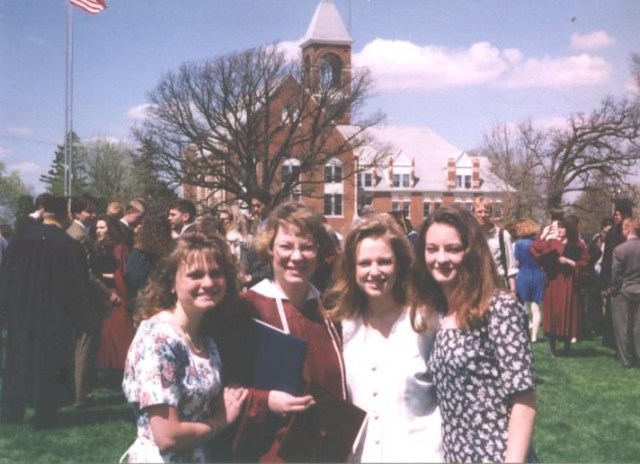
1995 Graduation Day at Pillsbury College

Amilee, my mom Becki, Ginger, and me in front of Old Main

This morning I ran past my old college, which was also my dad’s workplace during my junior high and high school years. It closed last year, and beside the sign that proudly bore its name for fifty years is another white one with red letters proclaiming, “For Sale.” My grieving process about this is complicated. Some days I feel like doing as Jenny did to her childhood house in Forrest Gump, and throwing rocks at the buildings. This morning I just felt melancholy, nostalgic, in the perfect mood to write a poem.

Pillsbury Presently Past
by Julia Tindall Bloom, June 13, 2009

come my college compatriots
let’s wander the sidewalks of our old campus
silent sidewalks, stretching sleepily
vaguely remembering the sound and motion
of glory days.

come my college classmates
let’s head to class
once-modern Pillsbury Hall
still smells, looks, feels like the seventies
i prefer the creaky floors
the cracked chalkboards
the clunky doors and windows
of ageless Old Main.

come my college teammates
let’s set up the volleyball net
in the machine-shed gym
it never looked like much
we never won much
but we got sweaty enough
the crowds were moved enough
we had our shining moments.

come my college roommate
time heals wounds
i wonder what it’s done to our old dorm room?
maybe not completely erased the canned-tuna odor
maybe a few sound waves from late-night talks
are still bouncing off those concrete blocks.

come my college sweetheart
let’s sit at that library table
where two child-adults fell in love
(dust is spreading there
over the remains of that flirtatious conversation)
then we could move to the stone bench by the flagpoles
where we fell out again
and gaze across the vacant campus
where we faded apart

years ago
a lone pianist in Kelly Hall
sent practice notes out the window
onto the breeze
some caught in branches of the old enormous trees
some floated up to Old Main’s bell tower
where they rest quietly now
along with the hollers and cheers of a hundred football games,
the ringing “Amens” of a thousand chapel services,
and every last whisper and sigh
breathed in this place.

rain still falls on these gracious lawns
water patiently drips from battered downspouts
life courses through this world
but not like it used to.

Good Girl, Humanized

I’m a pastor’s kid, AND . . . (I learned about the power of ‘and’ from my friend Cindy, who recently said labels too often keep us stuck. She said, for example, that although she is often impatient, she likes to say it like this – “I am impatient, AND I am learning to wait”).

So, I’m a pastor’s kid, AND I am learning to live boldly in spite of people’s opinions of me.

I was born to a Bible college student, and my younger brother was born to a seminarian. Our mother was a Bible college student’s wife, and then a seminarian’s wife, AND . . . although she wasn’t much encouraged to imagine the other side of the AND.

Officially I became a pastor’s kid (PK) when I was four and we moved to a tiny town in Rhode Island where my father became the pastor of a proportionally tiny church just about as old as America, with real steeple bells that the big boys got to ring every Sunday morning.

Two memories of our time at that church stand out to me. One morning, sitting in the front row with my mother and brother and a friend, I entertained myself and my friend during my father’s sermon by copying his gestures (with a bit of extra animation). Another Sunday, as my mother stood and sang in the choir, my three-year-old brother, terrified by a spider crawling on the pew beside him, ran to her and jumped in her arms.

After each of those services, I and my brother were respectively reprimanded for our antics. It may not have been spoken, but somehow we got the message that everyone was watching us, that we must behave well and not reflect poorly on our family.

It’s a lesson I learned early and well. Pastors’ kids, as people have over-generalized, are either angels or demons. I, proving the generalization, was a good girl in every way imaginable. Stepping into any new place when I was a child, my first concern was what the rules were, to make sure I kept them. As I grew into adolescence, so did the good girl. She was smart but quiet, pretty but safe in her always-modest dresses, passionate but only daring to hint at those passions through her handy talents of singing and writing.

Over the years my father went on his own journey of self-discovery and admitted that pastoring was something his mother had pushed on him more than he had desired. For a while I was a Bible college professor’s kid, at other times a salesman’s kid, a freelance writer’s kid, an unemployed man’s kid.

This past year I once again became a pastor’s kid, now with kids of my own. I’ve moved a long way from the good girl of my youth, not to rebel daughter, but to more confident, willingly weak, hungry, less-afraid, question-asking human. Very human. Repenting of the “we-they” “saved-lost” country club mentality from which I have operated most of my life growing up a pastor’s kid in church. The suitable-for-framing theology of my youth now looks to me just about as quaint and useless as my senior pictures.

This pastor’s kid wears shorts, drinks alcohol, plays rock music, goes to movies, and often votes Democrat. She also leads worship music in local churches, and regularly prays and reads her Bible. And she’s learned that abstaining from or exercising any of these things is a poor indicator of anyone’s faith.

The pastor whose kid I am has also changed. Now, when we meet on a Sunday evening after a morning when he was preaching and I was lounging in the back yard with my family and a cup of coffee, we smile and hug and talk about the past week, and the thought of what people might be thinking is as far away and irrelevant as the choir robe my mother wore that Sunday in Rhode Island.