Farewell to Theism

Tomorrow marks the one-year anniversary of the Sandy Hook Elementary School shooting which left 26 people, mostly children, dead. During that week, I wrote this post but didn’t publish it:

Any last vestiges of my personal belief in a theistic concept of God died with those children on Friday. No, an all-powerful, all-good God would never allow this.

I’ve been praying more. Not to Theos [Brian McLaren’s name for this concept of God], but to Jesus – the living breathing suffering broken life-force I call God. This isn’t about power and control, or even life and death. I don’t know what it’s about, except for being. Love, courage, hope and peace in the face of stinking rotten evil.

The God to whom I pray knows intricately the spider-web of actions, emotions, abuses, weather patterns, disasters, hungers, desires, kisses and curses that drove a man to gun down his mother and a roomful of children in mad cold blood. This God is all, not all-anything.

I have no idea about a point or a lesson to be learned from such a nightmare. I only have a softened broken heart and a longing for peace.

I still do. Every year. Like Bono sings,

Heaven on Earth
We need it now
I’m sick of all of this
Hanging around
Sick of sorrow
Sick of the pain
Sick of hearing again and again
That there’s gonna be
Peace on Earth . . .

Jesus in a song you wrote
The words are sticking in my throat
Peace on Earth
We hear it every Christmas time
But hope and history won’t rhyme
So what’s it worth?
This peace on Earth

Peace on earth, in the tradition of the Christmas story, is a baby-child. A mother’s arms. A starry night, a song, a meeting of strangers in a barn.

It’s a start.

The Snape in Me

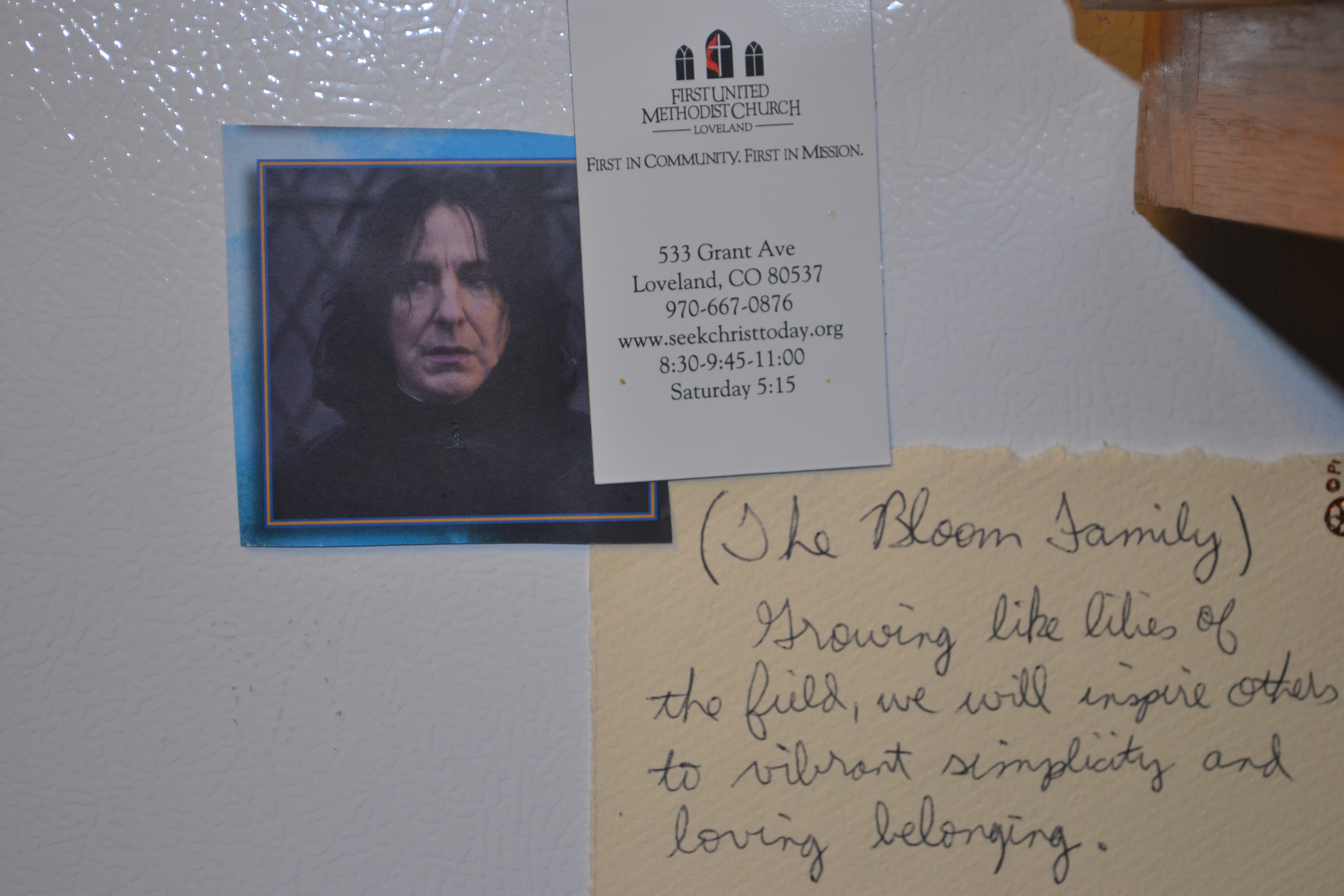
My literary hero and our family mission statement, inspiring me from the side of my refrigerator.

My literary hero and our family mission statement, inspiring me from the side of my refrigerator.

Note: This post contains a major Harry Potter spoiler. Leave now if you don’t know the story and want to discover it yourself! You have been warned!

My preteen daughter and I had a little fight the other day. I don’t even remember what it was about now. But afterwards, she made up to me by giving me a photo of Alan Rickman as Severus Snape that she had cut out from her Harry Potter poster book – which I promptly posted on the refrigerator, of course.

She did this because she knows I have a celebrity crush on Alan Rickman. But deeper than that, I am moved by the character of Severus Snape like few other fictional characters have moved me over the years. Probably because I can so relate to him.

Not in his abusive childhood, being bullied at school, or joining the Death Eaters. But in his tendency to be blistered by the light, his arrogance, distrust of shining heroes, cynicism, even his bitterness.

And, in his allegiance to that same light, his choice to ultimately serve Dumbledore the loving, generous, patient, wise and broken one rather than Voldemort the brilliant, unmoved, inapproachable, awe-inspiring mocker of goodness, the one who traded his own vulnerable soul for (he thought) impervious immortality.

Over the long haul, through the slow burn of my life, God has shown me a face more like Dumbledore than like the dark lord demanding a bloody sacrifice that the theology I learned in childhood implied.

And in spite of everything, I’m willing to do what this Dumbledore-God asks of me. I’m willing to be faithful to his way even when my cynicism and bitterness scream out in protest, mock the good and the true, scoff at the seeming naivete and utter unfairness of the way of love and grace with which I have thrown in my lot. I’ll hold on in faith to the bitter end, but I will never completely fit in or look the part (though I can come much closer than Snape since I haven’t been asked to work as a double agent!).

Harry Potter scholars (sure, why not?!) might point out that Snape was ultimately inspired by love for Lily more than faith in Dumbledore. And this is the part of the post where I proceed to quite likely over-season my metaphor with Christian theology:  I would suggest that Lily is the Christ-figure in Snape’s story, the embodiment of self-sacrificing love whose kindness and care for Snape in his youth continued to move him for the rest of his life.

Some of us are prone to self-importance, arrogance and cynicism. We may be the first to scoff at simplified statements of faith. We probably won’t trust you if you breezily assert that good always triumphs over evil, and we are pretty sure that we understand every situation more clearly, since we can see all the way down to the depths of despair, which we believe blind certainty in “happily ever after” won’t allow.

But don’t believe that we aren’t touched by love, and that we are incapable of choosing life and goodness (and even of growing kinder and more gracious in our behavior).

And please, don’t be intimidated by us. We are prone to negativity and brooding and can be generally anti-social, but we still like to sit at the head table with all the other professors, and sometimes our curmudgeonliness is the best way we have to interact with our fellow human beings, to let people know we are here and want to be in contact.

In conclusion, I would just like to say, “Everyone is different. No two people are not on fire.”

This I Believe

A few years ago, National Public Radio aired people reading essays they had written, reviving an older radio series called “This I Believe.” The project continues here

Last month, I challenged myself to write an essay about what I believe. I didn’t exactly follow the “This I Believe” guidelines, but it got me started. Since I have been particularly focused on faith and doubt, I wanted to write an essay exploring where exactly my theological beliefs are at.

Reading through this essay today, a month later, I can already see fault lines, places where shifts are happening. I can tell that when I wrote this, I was deep into Leo Tolstoy’s The Gospel in Brief: The Life of Jesus

I present this not as a statement of belief to be argued with (though you are welcome to respectfully interact with me around these ideas), but more as a challenge to you, to take a moment and hash out your own particular beliefs at this moment in your life. Not necessarily about theology (that just happened to be what was foremost in my mind when I wrote), but about whatever is moving and motivating you right now.

In the process of stating our own beliefs and considering how we arrived at them (and realizing how many times we have each changed our minds over the years), we hopefully become more patient with ourselves and one another in our thought and growth processes – and less afraid of being honest about our thoughts and beliefs at any particular moment of time.

This I Believe

July 25, 2013

I believe I am a product of the words and ideas that were poured into me, that surrounded me in my vulnerable childhood, that I chose to hear and heed as I grew into adulthood. I believe these ideas have taken deep root in me, and while I will always ask questions and seek new information and rethink, I continually live in conversation with these particular ideas. I may swing in wild reactive arcs, or hold fiercely in agreement, or deem an idea unimportant, but agreement or disagreement or indifference – none of it means departure. I can’t scrape off my mental DNA.

I believe I am nature as well as nurture. Something essential yet fluid is alive, growing here, withering there, becoming true – or false – in the onslaught of moments that make up my life.

I believe I am integral to the story of everything, and so is everything else. It isn’t as important as I often think it is for me to ponder my own integrality to the story of everything.

I believe in God, and I believe in Jesus. I believe God is the groundwork of all things, the only reality, the animating force, the source of life. I believe that Jesus was remarkably in touch with God, and called all of humanity to live in the same way. I believe that the notion of deity is irrelevant to the life and work of Jesus, that Jesus lived to be followed, not worshiped. I also believe that the notion of deity is irrelevant to the nature of God – that God is love, not overlord; truth, not dogma; life, not intelligent designer.

I believe in life before death. I believe life grows fuller as an individual reaches beyond self, embracing neighbor and stranger in love, which is God. I believe that life after death is incomprehensible from an individualistic perspective, and pondering this also is not as important as I tend to think it is.

I believe that my beliefs, while never completely uprooted from the ground of my nature and nurture, have changed in the past and will change in the future. But I believe that taking a snapshot of my beliefs in a particular moment is always helpful in clarifying why I do what I do, why I am who I am – right now today. More importantly, I believe that articulating my own current beliefs helps me to grow in love and understanding for others. I see the evolution of my beliefs, the holes and fault lines and stutters in my own thoughts, and I grow in patience and grace for the conflicting beliefs of neighbors and strangers.

Daydreaming and Dirty Dishes

Faith and doubt are two sides of the same coin, two legs of the same body. I can hop around on one or the other, but to really make forward progress, I need to use both, equally and in rhythm.

(I am broadly defining “faith” and “doubt” here. Faith – a sense of the transcendent/spiritual. Doubt – questioning/deconstructing.)

As with the rest of life, it’s easy to rely too much on one leg or the other. For much of my life, I hopped on my faith leg, jumped up on emotional worship songs and connect-the-dots life applications for Bible verses. For the past few years, I’ve been hopping on my doubt leg, cynical, skeptical, defining myself by what I do not believe.

Faith without doubt gets stuck. Faith’s transcendent visions, pursued without the push and pull of doubt’s probing questions, harden to ideological certainties, trading sails on ships on the sea for flags on poles in cement. Dreams and imagination and a hunger for the infinite are replaced with creeds, convictions, and a compulsion to hold tight to the “faith of our fathers.”

Doubt without faith can become equally inflexible, moving from honest engagement and open questioning to meeting every newborn idea with a certain cynicism. Doubt can become an intellectual and emotional posture of “no” that forgets how to play, imagine, daydream.

When I find I would much rather wash the dishes than play make-believe with my children (even if there are no dirty dishes to wash), then I start to wonder how well I’m using both of my legs.

Cynics and Church People

I came across this post by Addie Zierman last week. There is a lot I can identify with in Zierman’s post, although its conclusion  – that if church people are loving and honest about their own darkness and doubts, maybe the departed cynics will “find our way home” – felt a little too neat and tidy to me. Maybe I’m just overly attached to that quote from J.R.R. Tolkien: “not all those who wander are lost.”

Still, there’s so much I loved in Zierman’s post, like this:

After all, there’s not much you can say to us that we haven’t already learned in some Sunday School classroom somewhere. We know the Bible stories. We heard them over and over, year after year until they became part of our blood, part of our bones.

We’ve heard a thousand sermons. We recited Scripture on Wednesday nights and earned shiny little jewels for plastic crowns. We know the “right answers.” We know the Ten Commandments and the Fruits of the Spirit and how to “lead someone to Christ” with five Bible verses and a three-minute testimony.

And this:

But this is not about a program. We will see right through that flyer you stick in our mailbox. We have been bait-and-switched before, and we’re suspicious. We were raised on a steady of [sic] diet of ads and commercials, after all – we know when you’re trying to sell us something.

But you should follow the link (here it is again) and read the whole thing, if this conversation interests you.