Why I Wish I’d Kissed Him Sooner

My man and I have been through a lot together. Including a hands-off, touch-less pre-marital relationship.

Sixteen years later, we’re still living with the consequences of our choices.

Oh yes. I know, that sort of talk usually refers to the choice of “too much, too soon,” and I don’t disagree that we live in a hyper-sexualized culture. But for some of us, more needs to be said about the dangers of overly-prohibitive romances.

Nathan and I fell in love over our guitars. My first memory of him is a long-haired, earring-bedecked, goatee-trimmed Minnesota boy lazily strumming a guitar, sitting at the church missions fair behind his booth about his recent travels in Romania. I was hooked. He doesn’t remember much about the first time he met me, but he says he fell hard for me when I pulled out my guitar and sang a song I had recently written.

The summer of ’96 was one long conversation, deep into the night, punctuated with music and, I assume, eating and sleeping too.

But not touching. We had both been in previous relationships with a strong core of making out, and, doing our best to protect ourselves and one another from the dangers of sexual sin, about which we had heard plenty throughout our years in church youth groups, we agreed to a hands-off policy.

No, really. Hands-off. In premarital counseling with our pastor, when the subject of sex came up and he somehow discovered that we didn’t even hold hands, he looked concerned. He said something about light switches and wedding nights, akin to the idea of 0-60 in 10 seconds flat, and that maybe this wasn’t the healthiest way to go about building a marriage.

Considering his advice, we agreed to hold hands before our wedding.

The big day came, and soon enough, that first kiss. Of which I remember hardly anything. Shy and public are good descriptors. Hundreds of people observed this model couple’s first kiss, and I’m sad to say that we heard from more than one family afterwards, how our kissing decision was held up as a standard for their own children.

Listen, kids. Life is a struggle. We try things and fail, then try again, and sometimes we succeed. But always we grow, if we are willing to. That includes the decision my love and I made about touching each other. We have grown. But because we chose not to touch before our wedding, even while building profoundly deep emotional and cerebral bonds, we’ve had a little trouble connecting our sex life with the rest of our relationship.

The first few months, we were the stereotypical 1950’s newlyweds, exploring and enjoying sex like hungry adolescents. But if sex has been forbidden for most of your life, especially if you are a girl and are told you are responsible for protecting boys from temptation, then you can’t just jump right into it one day and feel that everything is good now. A subtle sense of self-loathing built up in me, which I began to vent by verbally abusing my husband, along with petty arguments, dramatic cry-fests over small disagreements, all of which seemed to come from a basic feeling that I was not lovable.

I wonder if a woman who has been told that sex makes her dirty, premarital sex makes her “damaged goods,” feels some sense of that consequence even after she has supposedly done everything right, secured the marriage license and kept all the rules.

And maybe it isn’t any easier for those couples who did kiss or – gasp – go further before their wedding, but felt compelled to hide this part of their relationship from that same church-induced sense of shame.

(And I am only beginning to listen to – and still far from truly understanding – the pain and shame heaped on anyone identifying beyond assumed heterosexual norms who grew up in church youth groups like mine.)

“It is not good for the [hu]man to be alone.” That’s fundamentally what sex is about – companionship, partnership, intimacy. As we parent our children, as we encourage the young ones – and really, everyone – in our midst, we must give one another space and grace to fail and grow in our reaching out for companionship, partnership, intimacy.

Go on. Kiss him. I’m talking to you, woman married twenty years who still habitually fends off the “temptation” to touch your husband.

A rough draft of this post has been in my drafts folder for nearly two months. Thanks to TC Larson for posting on this topic today and inspiring me to do the same.

Creatio Continua, a.k.a Evolution

How can evolution be both scientific theory and enricher of theology? John Haught explains:

The notion that God creates the world is, of course, central to the faith of millions. Traditionally, Christian theology spoke of three dimensions of God’s creative activity: original creation (creatio originalis), ongoing or continuous creation (creatio continua), and new creation or the fulfillment of creation (creatio nova). Prior to the scientific discoveries of cosmic and biological evolution, however, the latter two notions were usually eclipsed by the first. “Creation” meant primarily something that God did in the beginning. But even in the late nineteenth century a few theologians had already recognized that evolution implicitly liberates the notion of creation from confinement to cosmic origins. And although today discussions between scientists and theologians about God and the big bang often assume that “creation” is only about cosmic beginnings, the idea of evolution forbids such narrowing of so powerful a notion.

Indeed, the fact of evolution now allows theology to apprehend more palpably than ever that creation is not just an “original” but also an ongoing and constantly new reality. In an evolving cosmos, creation is still happening, no less in the present than “in the beginning.” The big bang universe continues to unfold, and so every day is still the “dawn of creation.” As Teilhard de Chardin put it, in an evolving universe “incessantly even if imperceptibly, the world is constantly emerging a little farther above nothingness.”

Moreover, evolution has allowed theology to acknowledge at last that the notion of an originally and instantaneously completed creation is theologically unthinkable in any case. If we could imagine it at all, we would have to conclude that an initial creation, one already finished and perfected from the beginning, could not be a creation truly distinct from its creator. Such a “world” would simply be an appendage of God, and not a world unto itself; nor could God conceivably transcend such a world. It would be a world without internal self-coherence, a world without a future, and, above all, a world devoid of life. By definition, living beings must continually transcend, or go beyond, themselves. As Henri Bergson said long ago, life is really a tendency rather than something rounded off and complete. An unfinished, or evolving, universe is essential to this tendency’s actualization.

(John F. Haught, God After Darwin: A Theology of Evolution (Westview Press, 2000), p. 37 from chapter 3, “Theology Since Darwin”)

The weight of evidence pointing towards evolution is often a crushing weight for someone, like me, brought up with a literalistic reading of the Bible. Usually one of two choices is made, both involving denial – deny the mountain of evidence for evolution, or deny the soul’s insistent dream of God.

My readings this morning seem to have converged around this point. Before I read the quoted passage above, Nathan and I read this at breakfast together:

In the depths of your hopes and desires lies your silent knowledge of the beyond;
And like seeds dreaming beneath the snow your heart dreams of spring.
Trust the dreams, for in them is hidden the gate to eternity.

(from The Prophet by Kahlil Gibran)

And later, I came across a blog post discussing this type of contrast as seen in a medieval painting:

Pisanello’s animals, tucked in their self-containing spaces, recall to me my scrappy outsider knowledge of the Australian Aboriginal Dreamtime, when all the manifest forms of creation lie sleeping inside the earth, waiting for songs to awaken them, to call them continuously into being. But here the Dream is fading, the song on the cusp of being mocked and forgotten, replaced by the angular, linear, technocratic visions that lie in wait beyond the cross and the promise of Renaissance that the future saint locks his eyes upon.

(from Cat’s blog The Place Between Stories)

I sense a growing polarity between thinking and dreaming in our culture these days. So I am grateful for the insistent thinker-dreamers among us. Open eyes, open minds, and open hearts keep us growing, unfinished, evolving, deeply alive in the continuing dawn of creation.

About That Museum You’re Building . . .

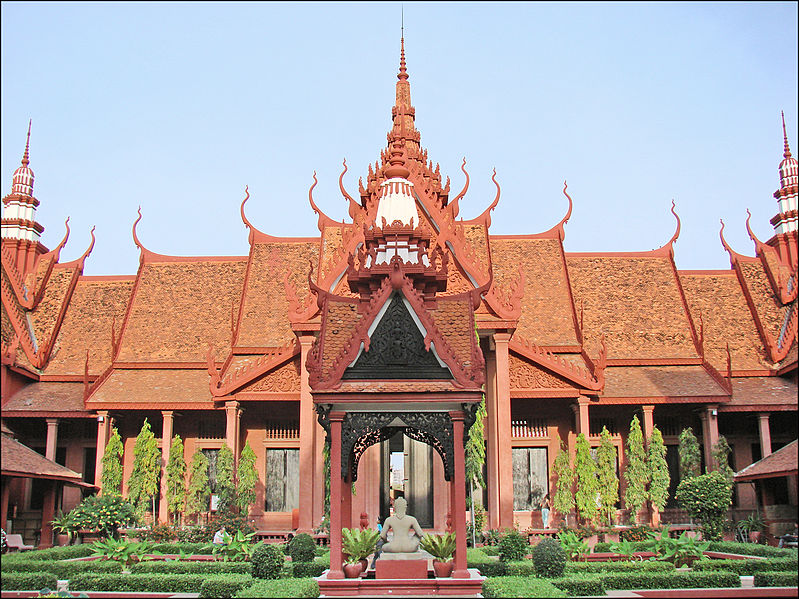
The Cambodian National Museum in Phnom Penh, Cambodia (Jean-Pierre Dalbéra)

The Cambodian National Museum in Phnom Penh, Cambodia (Jean-Pierre Dalbéra)

Do you have a Facebook account? Twitter feed? A blog? Any other form of social media presence? Then you, my friend, are a curator. Your friends/followers/readers are impacted by the choices you make about what information you share through your web presence.

Curatoraccording to Wikipedia, comes from the Latin word curare meaning “to take care.” A curator in a museum is responsible for deciding what items will be included in the museum’s exhibits, and how they will be presented to museumgoers.

Your Facebook wall, Twitter feed, Pinterest board, or whatever cyber-real-estate you manage, is a little museum curated by you. It is your opportunity to open a unique window on the world for those who visit it.

Social media is filled with smear campaigns, feedback loops, and general inanity. Insanity too, but a whole lot of inanity, which does sometimes fill a legitimate need we humans have to veg out once in a while. But when “once in a while” turns into everyday routine, it’s time to admit we have a problem.

Clear writing generally uses active voice rather than passive. I think this is true about life – including social media engagement – as well. Active living is simply more brilliant than passive.

Rather than passively scrolling and clicking, mind disengaged, reptile brain in charge as we react with our “likes” and “shares” and thoughtless comments, we could be taking the driver’s seat, creating something worthwhile, expanding horizons, opening windows, bringing fresh air and sunlight to otherwise drab, dank quarters.

If you’re ready to take charge of your role as curator, I suggest accepting Ryan Crocoduck’s New Year’s Challenge as a basic policy on which to build your own delightful piece of cyberspace.

Wishing you fresh air and wide horizons in the new year!

Farewell to Theism

Tomorrow marks the one-year anniversary of the Sandy Hook Elementary School shooting which left 26 people, mostly children, dead. During that week, I wrote this post but didn’t publish it:

Any last vestiges of my personal belief in a theistic concept of God died with those children on Friday. No, an all-powerful, all-good God would never allow this.

I’ve been praying more. Not to Theos [Brian McLaren’s name for this concept of God], but to Jesus – the living breathing suffering broken life-force I call God. This isn’t about power and control, or even life and death. I don’t know what it’s about, except for being. Love, courage, hope and peace in the face of stinking rotten evil.

The God to whom I pray knows intricately the spider-web of actions, emotions, abuses, weather patterns, disasters, hungers, desires, kisses and curses that drove a man to gun down his mother and a roomful of children in mad cold blood. This God is all, not all-anything.

I have no idea about a point or a lesson to be learned from such a nightmare. I only have a softened broken heart and a longing for peace.

I still do. Every year. Like Bono sings,

Heaven on Earth
We need it now
I’m sick of all of this
Hanging around
Sick of sorrow
Sick of the pain
Sick of hearing again and again
That there’s gonna be
Peace on Earth . . .

Jesus in a song you wrote
The words are sticking in my throat
Peace on Earth
We hear it every Christmas time
But hope and history won’t rhyme
So what’s it worth?
This peace on Earth

Peace on earth, in the tradition of the Christmas story, is a baby-child. A mother’s arms. A starry night, a song, a meeting of strangers in a barn.

It’s a start.