Some Soil

He spoke in a parable. He said

Some soil is just about dead

Walked over and worn out

Impervious to seeds,

A feeding trough for birds.


Some soil is stony:

Seeds sprout quickly,

Sprouts stretch to sun,

Sun scorches leaves,

Plant withers and dies.

No roots, he explained.


Some soil is preoccupied

Crowded with seeds of stubborn stock

That choke anything fresh

Before it can flower.


Some soil is just right

(To quote a golden-haired girl),

A dark loamy bed

Where seed bursts open in eager love,

Dying with life-force;

And soil honors seed’s sacrifice

Faithfully nurturing newborn sprout.


The seeds

I have gathered

Don’t come in uniform packets

Stamped with precise planting instructions.

They are scattered grains of life

Sown from everywhere:

Love letters and report cards, ocean waves and office buildings,

Toddlers’ tantrums, neighbors’ gossip,

Even radio talk shows and preachers’ sermons.


I have also

Discovered the soil

Doesn’t come in a bag

Purchased with indulgences and poured into the soul.

The best soil is made of wasted moments:

The garbage and leftovers of everyday life,

Piled in the back of the mind to rot,

Food for tiny creeping thoughts who give it back changed

Breaking up stony places

Crumbling softening

Light loose reborn

Hungry and thirsty for righteousness

A good place to put down roots.

Creatio Continua, a.k.a Evolution

How can evolution be both scientific theory and enricher of theology? John Haught explains:

The notion that God creates the world is, of course, central to the faith of millions. Traditionally, Christian theology spoke of three dimensions of God’s creative activity: original creation (creatio originalis), ongoing or continuous creation (creatio continua), and new creation or the fulfillment of creation (creatio nova). Prior to the scientific discoveries of cosmic and biological evolution, however, the latter two notions were usually eclipsed by the first. “Creation” meant primarily something that God did in the beginning. But even in the late nineteenth century a few theologians had already recognized that evolution implicitly liberates the notion of creation from confinement to cosmic origins. And although today discussions between scientists and theologians about God and the big bang often assume that “creation” is only about cosmic beginnings, the idea of evolution forbids such narrowing of so powerful a notion.

Indeed, the fact of evolution now allows theology to apprehend more palpably than ever that creation is not just an “original” but also an ongoing and constantly new reality. In an evolving cosmos, creation is still happening, no less in the present than “in the beginning.” The big bang universe continues to unfold, and so every day is still the “dawn of creation.” As Teilhard de Chardin put it, in an evolving universe “incessantly even if imperceptibly, the world is constantly emerging a little farther above nothingness.”

Moreover, evolution has allowed theology to acknowledge at last that the notion of an originally and instantaneously completed creation is theologically unthinkable in any case. If we could imagine it at all, we would have to conclude that an initial creation, one already finished and perfected from the beginning, could not be a creation truly distinct from its creator. Such a “world” would simply be an appendage of God, and not a world unto itself; nor could God conceivably transcend such a world. It would be a world without internal self-coherence, a world without a future, and, above all, a world devoid of life. By definition, living beings must continually transcend, or go beyond, themselves. As Henri Bergson said long ago, life is really a tendency rather than something rounded off and complete. An unfinished, or evolving, universe is essential to this tendency’s actualization.

(John F. Haught, God After Darwin: A Theology of Evolution (Westview Press, 2000), p. 37 from chapter 3, “Theology Since Darwin”)

The weight of evidence pointing towards evolution is often a crushing weight for someone, like me, brought up with a literalistic reading of the Bible. Usually one of two choices is made, both involving denial – deny the mountain of evidence for evolution, or deny the soul’s insistent dream of God.

My readings this morning seem to have converged around this point. Before I read the quoted passage above, Nathan and I read this at breakfast together:

In the depths of your hopes and desires lies your silent knowledge of the beyond;
And like seeds dreaming beneath the snow your heart dreams of spring.
Trust the dreams, for in them is hidden the gate to eternity.

(from The Prophet by Kahlil Gibran)

And later, I came across a blog post discussing this type of contrast as seen in a medieval painting:

Pisanello’s animals, tucked in their self-containing spaces, recall to me my scrappy outsider knowledge of the Australian Aboriginal Dreamtime, when all the manifest forms of creation lie sleeping inside the earth, waiting for songs to awaken them, to call them continuously into being. But here the Dream is fading, the song on the cusp of being mocked and forgotten, replaced by the angular, linear, technocratic visions that lie in wait beyond the cross and the promise of Renaissance that the future saint locks his eyes upon.

(from Cat’s blog The Place Between Stories)

I sense a growing polarity between thinking and dreaming in our culture these days. So I am grateful for the insistent thinker-dreamers among us. Open eyes, open minds, and open hearts keep us growing, unfinished, evolving, deeply alive in the continuing dawn of creation.

Rock me to Sleep Mother

Here is a rough, incomplete recording of a new song – an old poem I just set to music. Couldn’t sing it all the way through without crying the first five or ten times. See how well you can do! The words seem super-sentimental unless you are nearing forty and find them connecting with some deep primal mother-ache that just might have something to do with only ever seeing God as father all your life, because no one ever gave you words like this before.

Farewell to Theism

Tomorrow marks the one-year anniversary of the Sandy Hook Elementary School shooting which left 26 people, mostly children, dead. During that week, I wrote this post but didn’t publish it:

Any last vestiges of my personal belief in a theistic concept of God died with those children on Friday. No, an all-powerful, all-good God would never allow this.

I’ve been praying more. Not to Theos [Brian McLaren’s name for this concept of God], but to Jesus – the living breathing suffering broken life-force I call God. This isn’t about power and control, or even life and death. I don’t know what it’s about, except for being. Love, courage, hope and peace in the face of stinking rotten evil.

The God to whom I pray knows intricately the spider-web of actions, emotions, abuses, weather patterns, disasters, hungers, desires, kisses and curses that drove a man to gun down his mother and a roomful of children in mad cold blood. This God is all, not all-anything.

I have no idea about a point or a lesson to be learned from such a nightmare. I only have a softened broken heart and a longing for peace.

I still do. Every year. Like Bono sings,

Heaven on Earth
We need it now
I’m sick of all of this
Hanging around
Sick of sorrow
Sick of the pain
Sick of hearing again and again
That there’s gonna be
Peace on Earth . . .

Jesus in a song you wrote
The words are sticking in my throat
Peace on Earth
We hear it every Christmas time
But hope and history won’t rhyme
So what’s it worth?
This peace on Earth

Peace on earth, in the tradition of the Christmas story, is a baby-child. A mother’s arms. A starry night, a song, a meeting of strangers in a barn.

It’s a start.

God in a (Blue) Box and the Rise of the Wise Old Woman

© zir.com

© zir.com

Fifty years ago an unnamed time traveler appeared in the gap left when modernism and fundamentalism agreed that faith and science must be at war.

Known simply as the Doctor, he is the raggedy man, the intellectual genius who weeps and laughs, the miracle-worker with a profound comprehension of the physical laws of the universe, whose imagination, fierce hope and deep love enter into those laws, bending and transforming them. He is a scientific mastermind who can be taught, who can change his mind, who continues to explore and discover, to wonder – and wander.

A living breathing creature who lives and loves and loses and fights, who dies and resurrects (himself and others), who changes and is changed by his companions, his friends, creatures he meets only once, his enemies – anyone with whom he is in relationship.

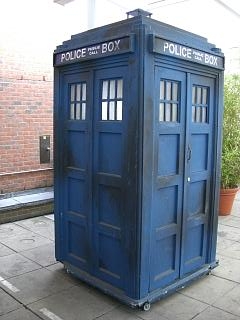
A god in a box. Which is bigger – immeasurably – on the inside.

The Doctor travels through all of space and time in his box, the TARDIS. He comes to help, to save, and often he comes especially to those who have lost hope, lost belief, lost imagination.

That’s why I’m hopelessly geeked-out on Doctor Who. If you’ve been with this blog – or me – for a while, you’ve seen me lose each of the above at times. I fought in the faith-science war, first on the faith side, then on the science side, and then I ventured into the unstable no-(wo)man’s land in between. Before I put my foot down on a land mine, though, the TARDIS whooshed in, and the Doctor, with his goofy smile and ancient eyes, invited me to fly with him.

I know. It’s only a TV show.

But there’s a story there. There’s a living idea that moves me.

My young son said to his father recently, “I can think of four wise old men – Gandalf, Obi-Wan, Dumbledore, and Sensei Wu.” I would add the Doctor to his list.

But the wise (someday old) man I love challenged our son to imagine more. He asked if he could think of any wise old women. The two of them thought hard, and together they came up with Galadriel and Professor McGonagall. I have yet to come up with any more from popular media. (Help me – can you think of more?)

With this dearth of wise old women, why would I latch onto yet another wise old (and so far very white) man?

Because if the Doctor has taught me anything, it is that everything that lives – even he – has a future. And that future, always true to the essence of the life from which it grows, often looks very different from the past. 

The wisest of old men and the most profound ancient stories are forever leaning forward, letting go of ego and convention, imagining the impossible.

I like to believe that the Doctor himself is a transitional and transformative figure in the evolution of human imagination – that in fifty more years, the Doctor will have helped to move us into a literary universe shining bright with wise old women.

Not only beautiful intelligent young women (a transitional and transformative figure of our current popular media), but also wise, wrinkled, heavy, gray, faded, quirky – even bearded! –  old women. Women who are respected, and heard, and believed in like I believe in the Doctor.

And Who knows what else?