Farewell to Virago

Minnesota motorcycle season started shockingly early in 2012. So after a couple years of borrowing or renting motorcycles for the occasional day trip with my Boomer biker parents, Nathan and I decided that 2012 was the year to buy one for ourselves. In March – yes, March! – on a sunny, warm spring day, we brought home a 2002 Yamaha Virago 250. Black, shiny, classic.

And we rode. Friday night dates, weekend rambles, and one four-day getaway to the North Shore, just the two of us, the road, the green earth, the wide living sky, the water and the trees, the friendly towns and quaint cafes.

There are many drug-free ways to free the mind, to unwind the soul and dip in a refreshing stream of ideas and impressions. But I have found nothing that compares to riding on the back of a motorcycle behind my best beloved, my denim-clad knees cutting into the clean wind, my booted feet resting solidly on the pegs. Riding with Nathan is a delightful blend of solitude and togetherness.

This year, we followed a dream that led us west, away from free and easy childcare (namely, our parents), towards climbing mountain roads – and therefore, away from child-free rides on a low-powered motorcycle, towards Nathan riding solo or with one of the kids on the bigger dual-purpose bike he recently bought.
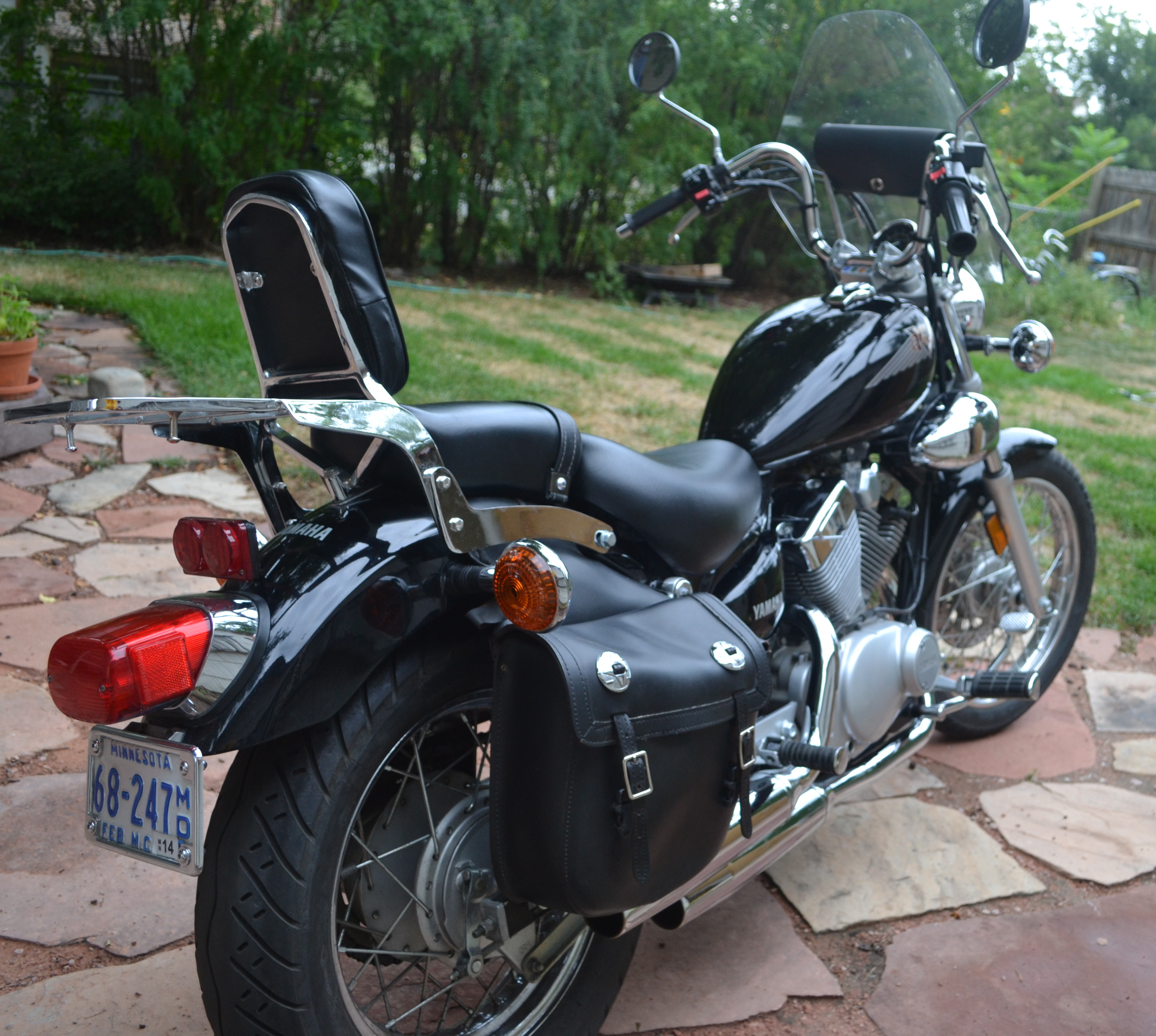
DSC_0036

So this week we pulled the Virago out of the garage to take some photos and make a Craigslist ad. Together we shined it up with soft cloths, and I said I felt sad. But as we talked and remembered that we had only bought the bike last year, I was comforted to realize how well we spent that time. We packed a lot of memories into that riding season, and I know we won’t sell them with the motorcycle.

In the future, only a few years from now when the kids are a little older, the two of us will probably ride regularly together again. And then, if we are still living in Colorado, our Friday night rides will be more majestic and adventurous than back roads through farm fields and prairie.

But whatever the future holds, farewell to the Virago means farewell to a chapter in our lives. A profoundly good and well-lived chapter, one I will read again from time to time in my memories, the photos we took, even the songs and poems I wrote in that larger-than-life, incredibly long Minnesota motorcycling season of 2012.

I posted a rough recording of one of those songs here. And below, a poem. (Instructional moment for non-bikers: in rude and sexist biker lingo, riding on the back of a motorcycle is called “riding bitch.”)

Riding Bitch, Refined

7/12/12 Julia Tindall Bloom

Viewed from the back of a bike

The world is poetry

Cows are bovine mother figures

The road is a ribbon

Every sparrow is joy embodied.

The retiree on his riding lawnmower

Is turning over Keats or Kerouac in his fertile mind

And the biker with whom we just traded the low sign

Is rolling through The Moldau in his memory

Because nothing else would do

As a soundtrack for this movie.

Note: I think I always associate Bedrich Smetana’s The Moldau with the road (even though it’s about a river) because my dad played it in our car’s cassette player when I was young and we were traveling. Here’s a link.

This Town

“It will never be this good again” is a lie we should stop telling ourselves. That’s what Todd Henry says in this article, whose content I first heard on his Accidental Creative podcast.

I’ve been facing down that particular lie with extra determination over the past year, as my husband Nathan and I made plans to move out of our Minnesota prairie hometown, across the country to the foothills of Colorado’s Rocky Mountains.

Nathan was born and raised in our hometown. I was born there, moved away at age nine months, moved back at age ten years, moved away at age twenty-two, moved back with my husband and children at age thirty. I joked that this town was like a bad penny that just kept turning up in my life. During the twelve years I spent growing up in this town, like many of my peers I dreamed of leaving it, not always appreciating the goodness and beauty all around me.

I married Nathan and then moved to the big city up the road, got a job, bought a house, birthed a child, conceived another – and then began to dream of moving back to the prairie town, where my parents lived, where I could walk the same park trails I walked as a teenager with my dog, eat at the hometown restaurants I knew so well, relive childhood memories and make new ones with my own children.

And that’s what we did – for seven storybook-perfect years. While I have always enjoyed traveling and even moving (in those years between nine months and ten years old, I moved with my family through four states and about a dozen homes, always excited to pack up and drive to the next place), now that we had two young children and all of their grandparents right in the same town, now that we had a (mortgage-free, rent-free) house and even perfectly scheduled part-time jobs so that neither of us took on the full load of domestic work or a full-time day job – it became difficult to see “it will never be this good again” as a lie. It felt like the inarguable truth.

We had always enjoyed visiting the mountains. Nathan took at least one trip to Colorado every year to do some adventuring. But whenever we had discussed possibly moving there, the call of the mountains was never quite strong enough to overcome the comfort and security of the prairie town.

Until last summer, when our little family was all there together, and for the first time, together, we felt the mountains moving us.

Our prairie town has no glaring deficiencies. Most people will tell you “it’s a great place to raise kids.” It is filled with beautiful parks and a sparkling river, kind people, small-town charm. It is the quintessential Shire, a happy idyllic space of farm fields, fragrant woods, and chatty neighbors. For seven years, our family lived well there, and many families have lived well for generations in this same town.

This song and account of my family’s move is not really about towns and mountains, you know. It’s about knowing when it’s time to step out, time to leave that comfortable thing you’ve always known for that strange and beautiful adventure that is undeniably calling to you. It’s about recognizing when your perfect situation is beginning to choke the life out of you, to smother you with security and lull you to complacency with its comforts.

It’s about embracing the unknown and holding out hope that unprecedented goodness lies ahead, not in the mountains or the prairie town or the shining city to which you are venturing, but in the journey itself.

Speaking of the Shire, I’ll call on J.R.R. Tolkien to close out this post. Here are three fitting quotes from The Fellowship of the Ring.

“The Road goes ever on and on
Down from the door where it began.
Now far ahead the Road has gone,
And I must follow, if I can,
Pursuing it with eager feet,
Until it joins some larger way
Where many paths and errands meet.
And whither then? I cannot say”

“Not all those who wander are lost.”

“All we have to decide is what to do with the time that is given us.”

Out On the Road

It’s April in Minnesota and our green breathing earth is covered with snow. But I still believe . . .

Lyrics:

Everywhere we look it seems that
Everyone has better things
to say to one another than the things we tell each other
Everything feels old and faded
Like those jeans that were your favorite
The ones with patches like the patches we’ve made for each other

but then we go

Out on the road
with the wind in our clothes
the sky overhead
and the green breathing earth
all around us

Every time it rains I tell myself
That somewhere something’s growing
And when I step outside tomorrow the world will be so clean
Every day you look at me like
Everything is new and though
I can’t believe, I still believe, I hold you in my arms

and then we go

Out on the road
with the wind in our clothes
the sky overhead
and the green breathing earth
all around us

Heart’s Desire

And if you catch your heart’s desire,

What then?

It isn’t the chase that tires

And confounds you,

That saps your strength

Hour by relentless hour.

It is the captive embrace

In which you guard your prize

While you wonder, what next?

With your desire breathing in your arms

Begging for a drink from your well.

What Women Want

Reading Everyday Blessings: The Inner Work of Mindful Parenting yesterday, I came across the story of Sir Gawain and the Loathely Lady. The authors’ retelling of the story shortens it and softens its rough medieval edges, focusing on the answer to its central question: what do all women really want?

If you have a few minutes, I suggest reading this translation of the story before coming back to this post. Spoilers follow this paragraph, and it’s a fun story to read before listening to further discussion of it. Especially this week, with Valentine’s Day coming up, I invite you to enjoy a romance that is decidedly of a different time and place! (Why do I suggest this particular translation? Because it appeared to be the most authentic translation of the original story that came up on the first page of Google results. Yes, thank you, I am such a scholar.)

In the story of Sir Gawain and the Loathely Lady (aka Dame Ragnell), we learn that what all women really want is sovereignty. When I read this story in Everyday Blessings, I thought for a minute that it couldn’t be an actual King Arthur story, spouting modern ideas like this one!

But reading the translation of the original, I see that “sovereignty” is treated more as “in charge of everything” than as “the right to rule oneself.” So that it may be more about the classic battle of the sexes, and the notion that in any relationship between two people, someone must always be in charge.

But, defining sovereignty as “the right to rule oneself,” I think this is a fitting answer to the question, and I might clarify further that women – just like men, just like politically-defined nations – want their sovereignty recognized, not bestowed (because it is no one else’s to bestow).

Or, as Mary Pipher writes in Reviving Ophelia (quoted in Everyday Blessings), though women all have different wants, each woman wants to be “the subject of her life and not [merely] the object of others’ lives.”