
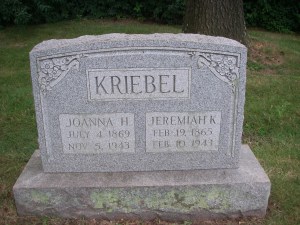
The headstone for my great-great-grandparents’ grave
Last month our family spent a week in and around Lansdale, Pennsylvania, visiting relatives in the land where my parents grew up. Nearby Philadelphia was the childhood home of my dad’s mother, whose own parents had come there from New York, and originally from Cuba (her father’s side) and Austria (her mother’s side). His father grew up an Ohio farm boy who joined the Navy young and moved his family around many times before settling near Lansdale when my dad was a small child.
My mother, however, was born in this area, as were her parents, her grandparents, her great-grandparents, and so on, back to the ancestor who arrived at the port of Philadelphia in 1734, on the ship St. Andrew, which carried German people known as Schwenkfelders seeking religious freedom.
While we were in Lansdale last month, my mother, my two children and I went to visit the Schwenkfelder Library and Heritage Center, where we connected more deeply with our roots and also knocked over a mannequin and climbed on things we weren’t supposed to (Mom and I did the connecting; Lu and Si did the knocking and climbing).
Afterwards, we stopped at the Towamencin Schwenkfelder Cemetery, which lies at the end of a short lane off a busy road which just happens to be Valley Forge Road, along which the Liberty Bell made an escape from Philadelphia to Allentown during the Revolutionary War.
The cemetery is surrounded by housing developments now, but at one time all that land was Vista Glen Farm, handed down the Schwenkfelder line from the 1700s until my mother’s grandparents, Harold and Ethel Kriebel, retired from farming and sold the land. When she was a small child, the age my daughter is now, my mom (a.k.a. “Little Becki” in the stories she tells my children) lived on that farm with her parents and older sister in one side of the farmhouse, and her grandparents in the other.

Luthien, Silas, and my mother, “Little Becki”
Here on this land, Little Becki played and explored. On the day we visited, grown-up Becki cried, flooded with memories as she stood in front of a row of gravestones resembling a series of books – the headstone of her grandparents, next to that of her great-grandparents, next to that of her great-great grandparents.
Her own mother, my grandmother Thelma, will probably not be buried here, because she made a choice that redirected the long line of German Schwenkfelder roots that she could trace back to the 1500s. Thelma married a Mennonite boy named Sam, who died when I was four and is now buried elsewhere. I imagine she wants to lie down next to him when it’s time. Until I stood in front of that headstone series, I hadn’t felt the significance of my grandmother’s redirection of the line.
There are six Schwenkfelder churches in the world, with roughly 3,000 members, and all are in southeastern Pennsylvania, where the Society of Schwenkfelders was formed in 1782. This is a long-held, short-ranged tradition. When Thelma married that Mennonite boy Sam, and together they joined the independent Baptist church, it forever altered the line. Now I, two generations removed, stand on the outside of the religious tradition of my forebears, looking in. Instead, I grew up an insider to the fundamentalist tradition towards which my grandparents turned the line, often wanting out.
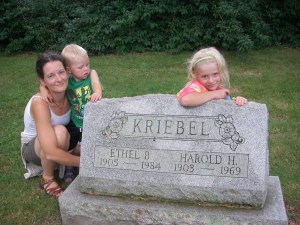
Me, Silas and Luthien at my great-grandparents’ gravestone
But I would not exist at all had it not been for her love and life with Sam, or for their little Becki’s union with Larry, my father. And now, because I chose Nathan, the son of Steve who himself redirected a long line of Minnesota Swedish immigrants by marrying JoAnne, there are two beautiful people in the world named Luthien and Silas.
Lately I’m very interested in tracing these lines. I’ve started searching for more genealogy information not just for my family but also for Nathan’s, and I find it fascinating to learn about the people from whom my children are descended.
Just as fascinating, I expect, are the people who may yet live because of the straightaways, twists and turns these lines have yet to take. They are lines of genes, traditions, ideas, sins and good works. Passed down the generations, woven in every union, birthed in every child, they make a living, changing, collaborative work of art full of beauty and shame, glory, struggle, pain and pride.
These lines are only in our hands for a little while. May we hold – and redirect – them well. And thank God they can always be redirected, or held, further down the line.
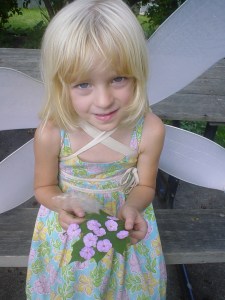 I live in a fairy forest. It’s a minuscule woodland, and I am its caretaker, while my five-year-old Luthien fancies herself its fairy princess.
 Julia Bloom