The Good, the Bad, and the Younglings

Danny DeVito made a movie in 1996 called Matilda, based on a book of the same name by Roald Dahl. A copy of this movie wound up in the bargain bin at a local video store, where my mother was browsing for something to entertain her grandkids so we adults could spend an evening in conversation which included complete sentences. My six-year-old daughter Luthien told me later about the movie and how much she liked it. Her favorite parts, which she described repeatedly, sounded lame to my adult sensibilities.

Typical kids’ story, I thought. Poor little child misunderstood by her parents (at least not orphaned like so much of children’s literature). People are either mean or nice, and she has some sort of magical powers to help her through her ordeals.

A week later when we took the kids to my parents’ house for a movie night, and Luthien asked to see Matilda again, I groaned and asked if we could please see something everyone would enjoy, not just the kids. But, poor misunderstood-by-my-parents me*, I was outvoted. On with the show.

Maybe it helped to have my enthusiastic fresh-faced daughter at my side, and her excessively giggly little brother primed to let loose at all the silly parts. I’m sure Danny DeVito and Rhea Perlman playing the outlandish parents helped too. Whatever it was, it turned out to be a fun movie to watch together with my kids. I gave my grown-up critic the night off and joined with my kids in relieved laughter when the victorious school children chased away their mean principal once and for all, hurling the contents of their lunch bags like a G-rated mob.

Later, when the grown-up critic came back from her night out and the kids were asleep, Nathan and I had a conversation (which included complete sentences).

“That movie bothered me,” Nathan began. “All those flat characters – the perfectly mean principal, the perfectly good teacher, named Miss Honey even?! Where’s the redemptive value in a story like that?”

Both of us having only in adulthood discovered subtlety (I love Jodi’s post about this), Nathan and I appreciate stories that humanize people. We remind ourselves and our children almost daily that there are no “bad” people and no “good” people – that every person is a complex being marbled with good and evil.

Classic children’s literature, however, does not often concur. Many of these stories tell about good people (who are usually underdogs and often children) winning by destroying bad people. We see it often in today’s movies for kids too. Up, which was a fun story idea and colorful and interesting to watch, disappointed us for the same reason. The bad guy, apparently, had to go.

Not all children’s stories conform to this standard, but in those that take the conflict of good versus evil as their theme, good and evil are often personified and therefore become polarized characters. Therefore the good character must destroy the bad character for good to triumph over evil. In a more complex story, the good character may do bad things (like Edmund in the Narnia chronicles), but ultimately that character will exhibit his/her inherent goodness through repentance. If there is character development, it will most likely be the good characters who get developed, and not the bad.

At least, that is the explanation I came up with when Nathan and I had this conversation and I tried to understand why children’s stories are not often redemptive.

No expert on childhood psychology (of which, as the parent of small children, I am more painfully aware than ever), I’m pretty sure I’ve heard somewhere that children are concrete thinkers; and I think this means that subtlety just isn’t something they get. So, maybe these stories help to cement into their concrete thinking the persistent human belief that no matter the odds, good will overcome evil in the end.

And maybe subtlety is something to be gained through maturity, interacting with the world, listening and observing others. Maybe the understanding that every person – and every situation – is complex and has something beautiful as well as something ugly or dangerous or evil in it can only come through experience, cannot be transferred through external teaching.

Taking this viewpoint, I think that Avatar should be classified as a children’s story (a highly interesting, predictably violent and visually stunning one) while Star Wars is for mature viewers.

Then again, even in Star Wars, the bad guy known as the Emperor never gets redemption. And maybe Darth Vader would just be classified as a good guy doing excessively bad things for an excessive amount of time until he repents and gets to be immortalized as good.

I dunno. It just feels deeply right and true to me when, as the Doctor triumphantly said in one of my favorite Doctor Who episodes, “Just this once, everybody lives!”

*Uh, Mom . . . Dad . . . my tongue is firmly in my cheek here. (Can’t afford to lose my biggest fans!)
Guest Post – My Mother’s Hands

Let’s stretch out Mother’s Day one more day, shall we? Here is a poem my mother wrote for her mother, and she gave me permission to post it here.

My Mother’s Hands
By Rebecca of Vista Glen Farm [copyright 2010 Rebecca Benner Tindall]

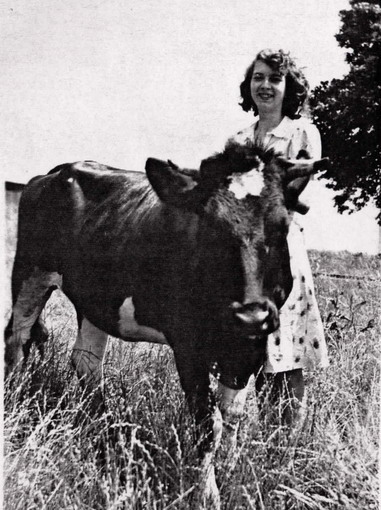
Thelma Benner (my Grammy), a young Pennsylvania farmgirl

My mother’s hands have
Guided a tractor across a stubbly cornfield

Shoveled manure in a smelly cow stall

Scattered cracked corn in a chicken house
Hoed stubborn weeds in an asparagus bed
Turned hard Pennsylvania clay soil to plant a flower bed
Gripped a pump handle to fill a bucket with water
Plucked a chicken and seared off the pin feathers with a candle

My mother’s hands have
Washed the grimy little hands and faces of daughters who made mud pies
Turned the crank of a wringer washer
Rinsed, washed and folded thousands of diapers
Hung little dresses, undershirts and socks in a row on the wash line
Sewed detailed clothes for all sizes of doll babies
Cut the fabric, designed and stitched matching Easter outfits for her little ladies
Scraped, washed, rinsed, and dried stacks of Thanksgiving dishes

My mother’s hands have
Canned the sweetest peaches in the world
Opened a jar of mouth-watering canned cherries
Chopped vegetables for a fresh batch of Pennsylvania Dutch piccalilli
Rolled out crust for a tasty apple pie
Poured a cold glass of milk for a little girl from an old mayonnaise jar

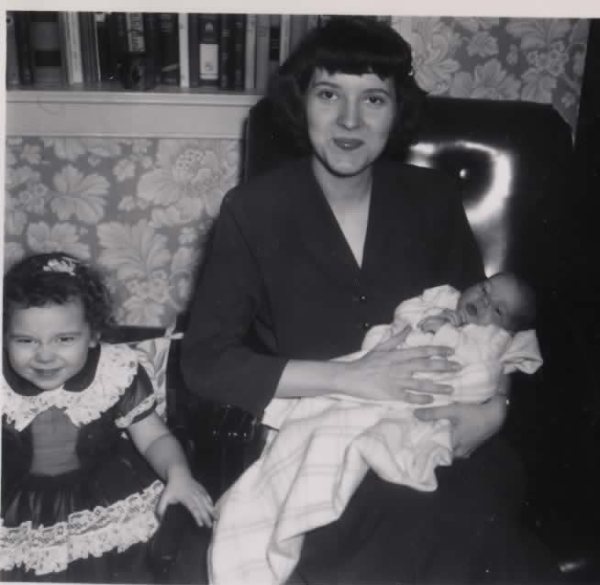
Thelma with daughters Debby and Becki

My mother’s hands have
Rocked a lapful of little girls
Felt the hot forehead of a daughter with rheumatic fever
Changed the cloth diapers of four baby daughters
Tested the milk for a night-time bottle
Held the big Bible story book for bedtime reading
Washed out with soap the mouth of a naughty little girl
Poured bubble bath into a big white tub for squealing little ladies
Tucked in the covers around her little daughter’s leg braces

Sam, Thelma and their daughters

My mother’s hands have
Packed a lunch box with a bologna sandwich and an apple
Filled a thermos with farm-fresh milk
Lined up Sunday School papers on the refrigerator
Written checks for school photos
Signed permission slips for field trips sent home by the teacher
Checked the math on little girls’ homework assignments
Filled a jar with water for fresh-picked dandelions

My mother’s hands have
Dribbled a basketball
Strummed the strings of a Hawaiian guitar

Clicked away on the keys of a manual typewriter
Done the bookkeeping for a basket manufacturer
Lifted a patient in a nursing home
Wiped the noses of her nursery school class

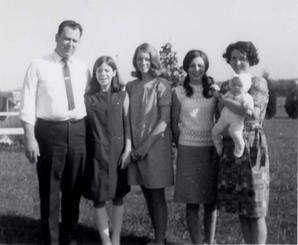
Thelma and Sam 25th annviersary

My mother’s hands have
Held the test results that pronounced the sentence of cancer
Spent all her savings on medicine hoping to prolong the life of her daughters’ daddy
Adjusted the covers of her dying middle-aged husband
Torn up old sheets to make bandages for his oozing sores
Tenderly held her husband when she kissed him goodbye
Held the death certificate of her lover and friend
Laid a flower on his casket
Wiped away tears of sorrow and loneliness

My mother’s hands have
Gripped her Bible late at night under a dim lamp
Clasped together in prayer asking God for money to pay the utilities
Opened old jars of canned peaches to feed hungry children
Accepted a bag of potatoes from a friend
Poured a glass of water for a deacon visiting his assigned widow

Great-granddaughter, son-in-law, Grammy, grandson (behind her - really, not great-grandson, but my cousin!) 2008

My mother’s hands have
Blessed four daughters
Cradled four granddaughters, six grandsons and one great-nephew
Touched the faces of eight great-granddaughters and five great-grandsons (so far)!

I love you, Mom.
Happy Mother’s Day, May 9, 2010
From your Blue-Eyed Girl, Rebecca Jane.

A Long Line, Redirected

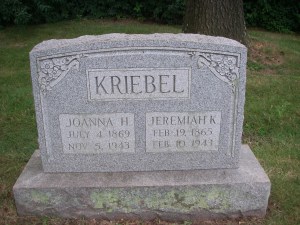
Joanna and Jeremiah Kriebel, my great-great-grandparents

The headstone for my great-great-grandparents’ grave

Last month our family spent a week in and around Lansdale, Pennsylvania, visiting relatives in the land where my parents grew up. Nearby Philadelphia was the childhood home of my dad’s mother, whose own parents had come there from New York, and originally from Cuba (her father’s side) and Austria (her mother’s side). His father grew up an Ohio farm boy who joined the Navy young and moved his family around many times before settling near Lansdale when my dad was a small child.

My mother, however, was born in this area, as were her parents, her grandparents, her great-grandparents, and so on, back to the ancestor who arrived at the port of Philadelphia in 1734, on the ship St. Andrew, which carried German people known as Schwenkfelders seeking religious freedom.

While we were in Lansdale last month, my mother, my two children and I went to visit the Schwenkfelder Library and Heritage Center, where we connected more deeply with our roots and also knocked over a mannequin and climbed on things we weren’t supposed to (Mom and I did the connecting; Lu and Si did the knocking and climbing).

Afterwards, we stopped at the Towamencin Schwenkfelder Cemetery, which lies at the end of a short lane off a busy road which just happens to be Valley Forge Road, along which the Liberty Bell made an escape from Philadelphia to Allentown during the Revolutionary War.

The cemetery is surrounded by housing developments now, but at one time all that land was Vista Glen Farm, handed down the Schwenkfelder line from the 1700s until my mother’s grandparents, Harold and Ethel Kriebel, retired from farming and sold the land. When she was a small child, the age my daughter is now, my mom (a.k.a. “Little Becki” in the stories she tells my children) lived on that farm with her parents and older sister in one side of the farmhouse, and her grandparents in the other.

Luthien, Silas, and my mother, "Little Becki"

Luthien, Silas, and my mother, “Little Becki”

Here on this land, Little Becki played and explored. On the day we visited, grown-up Becki cried, flooded with memories as she stood in front of a row of gravestones resembling a series of books – the headstone of her grandparents, next to that of her great-grandparents, next to that of her great-great grandparents.

Her own mother, my grandmother Thelma, will probably not be buried here, because she made a choice that redirected the long line of German Schwenkfelder roots that she could trace back to the 1500s. Thelma married a Mennonite boy named Sam, who died when I was four and is now buried elsewhere. I imagine she wants to lie down next to him when it’s time. Until I stood in front of that headstone series, I hadn’t felt the significance of my grandmother’s redirection of the line.

There are six Schwenkfelder churches in the world, with roughly 3,000 members, and all are in southeastern Pennsylvania, where the Society of Schwenkfelders was formed in 1782. This is a long-held, short-ranged tradition. When Thelma married that Mennonite boy Sam, and together they joined the independent Baptist church, it forever altered the line. Now I, two generations removed, stand on the outside of the religious tradition of my forebears, looking in. Instead, I grew up an insider to the fundamentalist tradition towards which my grandparents turned the line, often wanting out.

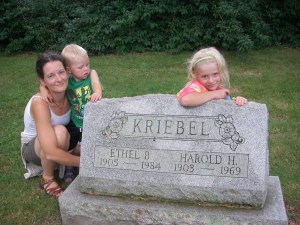
Me, Silas and Luthien at my great-grandparents' gravestone, Towamencin Schwenkfelder Cemetery

Me, Silas and Luthien at my great-grandparents’ gravestone

But I would not exist at all had it not been for her love and life with Sam, or for their little Becki’s union with Larry, my father. And now, because I chose Nathan, the son of Steve who himself redirected a long line of Minnesota Swedish immigrants by marrying JoAnne, there are two beautiful people in the world named Luthien and Silas.

Lately I’m very interested in tracing these lines. I’ve started searching for more genealogy information not just for my family but also for Nathan’s, and I find it fascinating to learn about the people from whom my children are descended.

Just as fascinating, I expect, are the people who may yet live because of the straightaways, twists and turns these lines have yet to take. They are lines of genes, traditions, ideas, sins and good works. Passed down the generations, woven in every union, birthed in every child, they make a living, changing, collaborative work of art full of beauty and shame, glory, struggle, pain and pride.

These lines are only in our hands for a little while. May we hold – and redirect – them well. And thank God they can always be redirected, or held, further down the line.