Swallowed Whole by the Internet

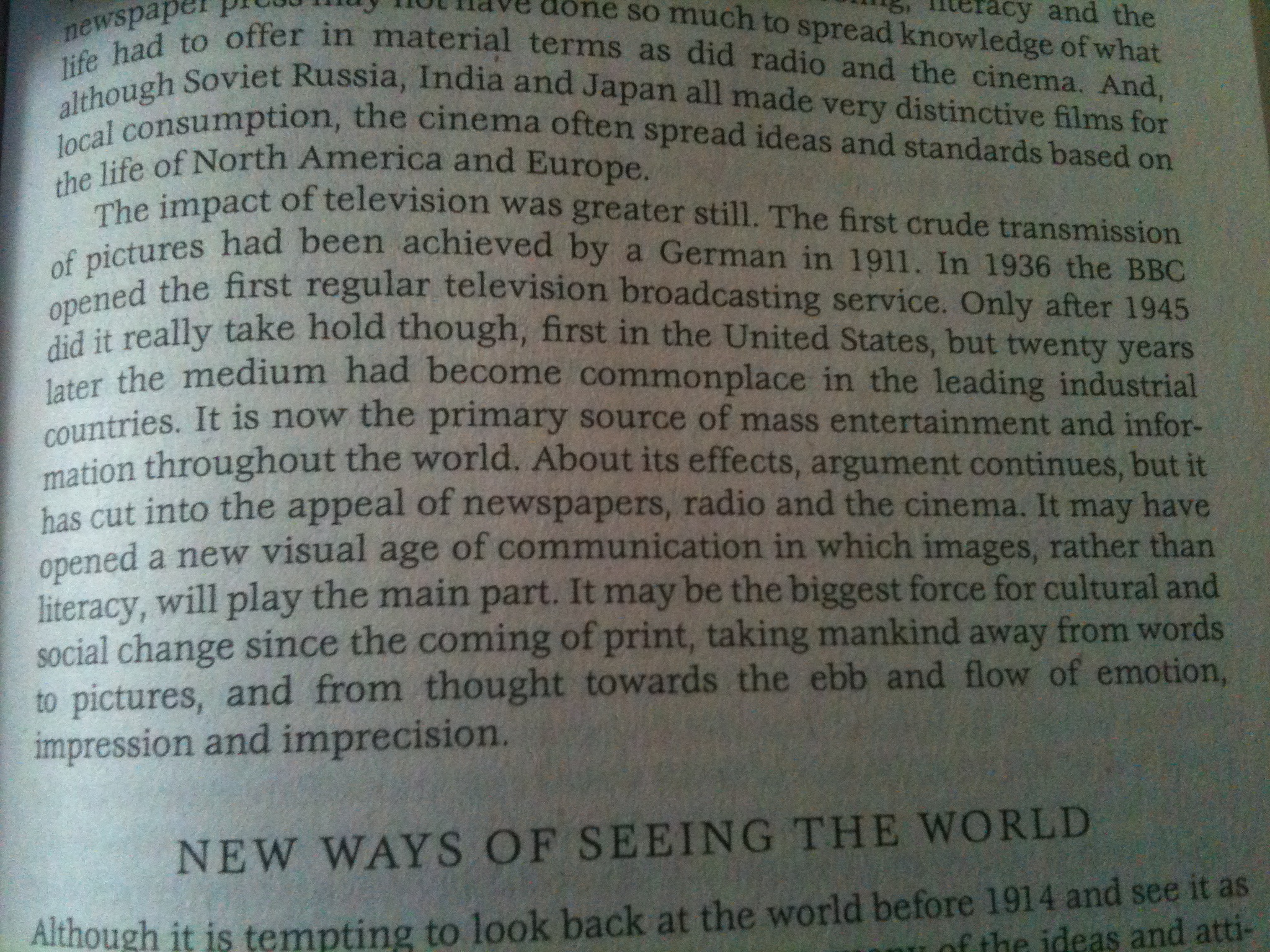
Short History passage

From A Short History of the World by J.M. Roberts, published 1993 by Oxford University Press.

The above words were published in 1993, only a couple years before the Internet began to catch on (I remember starting to use e-mail around 1995). I find them fascinating. If you start reading at “It is now the primary source of mass entertainment and information throughout the world . . .” and continue through the end of the paragraph, you could just as easily now say all of this about the Internet. But this author was writing about television.

Marking 1936 as the dawn of television as we know it, I wonder if this prophesied “biggest force for cultural and social change since the coming of print” will even last 100 years.  And then I wonder about the world-wide-web in comparison. Is this another “big new thing” that turns out to have a human-sized life-span? Or is it truly as much of a game-changer as the printing press (or more)?

Television’s days now look to be numbered, and even the printing press doesn’t run like it used to. The Internet incorporates both images and words. Images do seem to play a larger role in our general discourse than they did before the days of television, and I see no sign of that changing through our Internet use. But words continue to coexist with images, and if anything, it might be argued that the apparent triumph of Internet over television is evidence that words continue to be valued along with pictures. We want to be able to talk about what we are seeing.

The connectivity and interactive nature of the Internet certainly make it a more powerful and pervasive force than television ever was. And in actuality, rather than competing or usurping, the Internet seems to be simply swallowing and reconstituting television – along with radio, newspapers, the telephone, the personal letter, the community bulletin board, the music industry, maybe even the printing press.

What do you think?

Is the Internet here to stay?

Is our culture driven more by pictures or by words, and has the Internet changed anything about that?

Does the prevalence of the Internet over television signify a more thoughtful culture, or have we grown even less intelligent and more entrenched in our points of view than we were when we only had TV? (Now we have way more information available to us, but we can more easily find people and perspectives that reinforce our own static thinking. In the glory days of television, information and ideas were much more limited but, ironically, we were more likely to be exposed to people and ideas we might disagree with. True? Or not exactly?)

Has anything actually been swallowed whole by the Internet? Or will anything be? Or will we always have, operating apart from the world-wide-web, things like radio, newspaper, television, etc.?

And is that an image at the top of this post or is it words?

Other People’s Work

Read any good books lately (besides your own)?

Frederick Buechner said, “the place God calls you to is the place where your deep gladness and the world’s deep hunger meet.” It is exhilarating to discover this place and then get to work in it, pay or no pay, day job or not, published book or engaging tweet.

But without a healthy sense of self, a grown-up level of security in our personhood, we creative-types* can begin to identify ourselves with our work. We become the work we make. And then, instead of celebrating the good work that other people do in our same field or genre, we start to compare our work (ourselves) with theirs, become annoyed and critical, and sometimes just stop listening to, looking at, or reading other people’s work altogether.

Nobody can tell it, write it, sing it, film it, or whatever your thing is – like you can. But you are one voice among hundreds or thousands, maybe even millions, depending on your particular medium – and each of those voices is also unique. Some of those creators are better at using their voices than others, some are still working to find their own voice at all. You are in there too, somewhere on that continuum.

There will always be people who make better work than you do. “Better” is wildly subjective and depends on all sorts of things like budget, public opinion, connections, aesthetic, age, experience . . .

But as I’ve listened to and learned from creators I consider to be “better,” I’ve seen a common thread. These are people who pay attention to other people’s work. Musicians who rave about other musicians, poets who immerse themselves in other people’s poetry, filmmakers who go into great detail describing how other people’s films have inspired them. And they tend to seek out work they consider better than their own.

That takes a healthy sense of self, a realistic perspective on one’s own work and calling. It’s humbling to remember that other people picked up guitars and made up songs before I could tie my shoes – that I was not the one to discover music. Sounds crazy-obvious and astonishingly arrogant when I say it like that, but these are the sorts of unvoiced exaggerations self-delusion sneaks into our minds if we don’t acquaint those minds with the voices and work of other people (I know, because I’ve been there).

And so, I think that one significant mark of maturity in a creative life is when you can be moved, inspired, and challenged by the work of another (especially a peer, someone living and working in your field, even in your particular circle of influence), without feeling threatened, jealous, hyper-critical, or compelled to copy.

I’m not saying that these feelings shouldn’t surface as we interact with other people’s work. In fact, they almost certainly will and should as we mature, but if we recognize them for what they are and continue to create in spite of them, they will prove to be very helpful teachers and teach themselves right out of a job.

So hit the library and grab a book of poems, subscribe to somebody else’s blog, go out and hear another singer/songwriter at your local coffee shop, go to somebody else’s gallery opening. And feel your mind broaden, and say a little word of thanks for all the brilliant voices in the world.

* In this post I’m writing specifically from my perspective as someone who tries to create on a regular basis, but these ideas could probably apply in other fields of work as well, and I’d be interested to hear your thoughts on that.

Bread of Life

God’s fingers were floury from kneading the bread dough.

She wiped them on her apron

Then stooped to pick up the baby

(He had been crying and pulled himself up by her pant leg, his snot and

tears spotting her jeans at the thigh)

She kissed his cushy cheek

Hoisted him on her hip

Smoothed a stray strand of hair

And laughed when he sneezed unexpectedly.

On the radio the band struck up a tune

So she took his chubby hand in her callused one

And they danced around the kitchen

Afternoon sun dappling the linoleum

School buses whooshing by outside

Neighborhood children chattering down the sidewalk

And there in the middle of it all,

Bread dough rising quietly.

Apple of My Eye

In early June in Minnesota this year, it seemed we lived in a world of rain, a land of gray. I think we spent two continuous weeks under granite skies, and my nine-year-old daughter began to feel it in her light-hungry soul. The perpetual gloom, combined with the haunting bedtime thoughts about death and loss that are common to her age, brought an above-average precipitation of tears welling up from a previously-unplumbed depth of grief and questions in her being. We were packing to move across the country that month, far from the familiar hugs of grandparents, a thousand miles from the back doors of the neighbor girls she loved like sisters.

This girl was not my idea. I was not inclined towards having children, because although I have always adored babies, children (those little people who want birthday parties and sleepovers and repeat, “watch this!” over and over and interrupt intelligent conversations to repeat their favorite lines from inane movies and litter the world with cheap plastic toys and fingernail polish) are not my strong suit.

I was a child once. And this does give me a window on my own daughter’s childhood. But just as her birth was not my idea, neither is her self. As I wrote here, she is a whirlwind of imagination and action. My child self was a model of compliance. Trying to understand her most mystifying elements through the lens of my childhood too easily leads to comparison and value judgments.

But when I remember that Luthien was never my idea, and that her continuing unfolding is not my idea, I relax a little more into the One whose bright and colorful idea she is. I support, encourage, seek to inspire, educate, discipline, celebrate and love this inexplicable human, but she is not my grand idea to be worked out precisely the way I think best.

She is the apple of my eye and the stars in my night sky, but apples don’t feed eyes and stars at night don’t keep their beholder warm. My baby, my child, my girl came from me, changed and changes me, has marked me forever – and yet, she has her own road to travel, distinct from but ever intertwined with mine.

Here’s a song I wrote in those gray weeks in June.

Lyrics:

You are the apple of my eye

But eyes cannot eat apples

You are the stars in my night sky

But stars are too far away to keep me warm

You are my darling baby girl

And babies need their mothers

I am your faithful failing world

I rock you in my arms and cry along

A long long night

Oh will it ever end?

A hard hard fight

I wish we both could win

You are a flash of color bright

Inside a kaleidoscope

You ask me sometimes late at night

Is anybody there looking through?

You are a mirror in the woods

Reflecting all around you

You show the trees they’re looking good

But secretly you’re lonely for a face

A face of love

A face with patient eyes

A face you’ll know

From your feeling of surprise

You’re growing into summer now

You’re thirsty like a flower

With all my heart I’ll show you how

To spread your petals out and drink the rain

The rain that soaks

And chills you to the roots

But don’t lose hope

The sun will come out too.

Resetting Your Life

Do you ever wish your life had a reset button, like an iPhone? Ever left the house door unlocked on your way out with a secret hope that someone will break in and take all your stuff while you’re gone? Or subconsciously wished for a layoff or a house fire so you could start with a clean slate?

Life gets busy, our stuff weighs us down, our routines become tiresome ruts and we bore ourselves. Sometimes we (or at least some of us) start dreaming about a whole-life reset in these cases, and sometimes that can be just the thing.

But making smaller changes can bring surprising depths of refreshment and energy to our lives as well. Choosing one facet of life to tweak or experiment with can bring great joy and creativity to a complete life.

Here are some things I’ve learned in my own experiences of life-tweaking:

It’s okay to change your mind. Going into any new venture with this attitude can greatly relieve the pressure you feel to make it work, and thereby, ironically, help you succeed. Or, if you get going and find out it’s just not your thing, this mindset gives you permission to stop and move on to something else, guilt-free. Politicians are always accusing one another of “waffling,” changing their minds, as if thinking and doing the same thing all your life is a measure of good character. I say that’s a measure of obstinacy and stagnation. People who are alive and growing will certainly change their minds. (Of course not everything is entered into this lightly. Commitments you make to people – especially family relationships such as marriage and parenting – are made on a deeper level than “life-tweaking,” and aren’t part of this discussion. You may decide on other non/less-negotiables for yourself as well.)

Give it some time. This balances the above point. Most new things feel strange and ill-fitting at first. Starting something new requires a certain level of commitment and discipline to attain some level of skill or comfort with it. Maybe you will make different demands of yourself for different activities. But it helps sometimes to look back at past accomplishments or adventures that felt “all wrong” when you started, which after you acquired some skills and familiarity became favorite activities. A certain degree of stoicism, “just do it” mentality is needed for any new venture in life.

Accept loss forever.” (Jack Kerouac) Some things simply will not be for you. Certain dreams, romantic attachments, friendships, business ideas, career paths, and loved ones have died in each of our lives. We can cherish memories from these treasures we have lost, but we can’t remake them. Resurrection always takes a new form. The end of the caterpillar is the start of the butterfly; the burial of the seed is the birth of the flower. Your particular losses are the rich soil of the new creation of your life. Don’t hold on to the wispy ghosts of dead things. Let them die so new life can begin.

Start small. Nathan and I once dreamed of selling our house and living on a sailboat. I, the impulsive extremist, wanted to jump in and do it right away. Nathan, the careful adventurer, advised that we buy a small sailboat, learn to sail, take some weekend trips, and see what we thought. We did this, and I learned that I got seasick easily, realized that I loved gardening and would miss it, and then found out we were pregnant with our first child. We made some great memories with our small sailboat, and when the time seemed right, we sold it. Maybe living aboard is still in our future, but it was good to test the waters rather than diving right in.

Or dive right in! Evaluate your situation, the people potentially affected by the change you want to make (are you single or married? do you have young children? are your parents aging and needing more support from you? are you in debt?), and dive accordingly. I do think every person can benefit from at least one impulsive leap in life. “Impulsive” may mean different things for different people though.

Ask yourself, “what’s the worst that could happen?” When you honestly face that question, the potential risk often doesn’t seem so scary. Remember that risk has two sides – something can be lost, but something can also be gained. Are you willing to lose the one thing in order to potentially gain the other? Or are you committed to keeping the one thing and therefore erasing any chance of gaining the other?

Re-evaluate from time to time. Just because you rejected an idea at age twenty doesn’t mean it still can’t work at age forty. So much about us changes over the years, regardless of the external changes we make to our lives. Career positions, stages of family life, physical health, interests, abilities, worldview, daily habits – all of these and plenty more can change multiple times throughout our lives, and can affect our openness to new opportunities.

What life-tweaks and experiments have you made, or what are you considering trying? What would you add to or change about the advice above?