In Twenty Years

I attended my friend Victoria Peterson-Hilleque’s poetry reading last night. She, along with her colleagues Sarah, Andrea, Didi, and Jill shared poems from the manuscripts they created for completion of the Master of Fine Arts degree in creative writing at Hamline University. I enjoyed all the poets’ works, and am especially honored to know Victoria and excited for her accomplishment!

Inspired by these writers, I am posting a poem, and purpose to do so more often.

In Twenty Years

© 3/10/2010 Julia Tindall Bloom

In twenty years, maybe less,

These are the things I will wistfully remember:

A small black shoe

A downy white feather

A wide red ribbon

Two silvery little ice skates

A garish plastic necklace

A child-sized guitar

A shoebox-sized pick-up truck

Seashells

Rocks

Tiny socks

And a young artist’s scattered portfolio

All these in random places and positions

Throughout my living space

Offending my orderly sensibilities

But alive with the news

Of the burgeoning existences

Of Luthien and Silas.

Also Ran

Sunshine and snow, fresh air and movement beat sitting in front of a light box any day. I’m not about to dispute the existence of seasonal affective disorder (SAD), or even traditional medicine’s high-tech ways of treating it.

All I’m saying is that after a run on a sunny day in a snowy place, I come home floating.

Running has been a comfort source throughout my life, a primal behavior I turn to when life gets complicated. Of course I ran as a child – didn’t we all? Then in adolescence, overdosed on Rocky movies and determined to stop sitting the volleyball bench, I ran again, and was not disappointed. Throughout my young adult life, changes and difficulties and disappointments have thrust me out of the house, running away, chasing down solutions, rocking my inner child to the elemental rhythm of breathing in and out, pumping legs up and down.

Christopher McDougall has written a love story-science lesson-history-sociological study-adventure tale about running that has jolted me even more joyfully out the door these days. Reading his book Born to Run has left me feeling like Forrest Gump, (“runninG” with a good hard “g” at the end); or like Silas, my three-year-old, who spontaneously runs back and forth the length of our house while telling stories about himself, every day, often a few times a day. Like a ten-year-old, I read McDougall’s tale of running with ultra-marathoners and Tarahumara Indians, twenty, fifty, a hundred miles down the trails, and I am right there with them. I am Scott Jurek, the vegan ultra-runner stocking his fanny pack with pitas and hummus rather than high-falutin’ power gels. No, wait, I am Barefoot Ted, caressing terra firma with my bare soles. But then, too, I must be Ann Trason, 5’4″ and unstoppable, dubbed “La Bruja” (the witch) as she zooms past legendary Tarahumara running men including Juan Herrera and Martimano Cervantes in the Leadville Trail 100.

Ten-year-old me, immersed in other people’s stories, thrusts 34-year-old me out into the sunny snowy February day, and as together we chase down Scott and Ted and Ann, my head clears, my heart pumps, and I am me, alive and free and really me, also born to run; and my three miles through the parks of this Midwestern prairie town is brilliant, right up there with sex and drugs and rock and roll – except the drugs, that is, because this kind of inhaling is actually good for me, my favorite drug to treat my level of SADness.

Fighting February

In the hot and busy hustle of growing, harvesting, and preserving summer’s bounty, winter sounds like a dreamy relaxing bubble bath. There I am in my mind’s eye, serenely lounging in a rocking chair, wrapped in a cozy blanket, backlit with candlelight. On the table next to me steams a mug of green tea, next to a small dish of dark chocolate and crystallized ginger from which I occasionally eat. I am reading Plato’s Republic. The children are in bed, my lover is softly strumming a guitar on the couch. The dishes are washed, the laundry is folded and put away, there is a pot of beans soaking for tomorrow’s dinner.

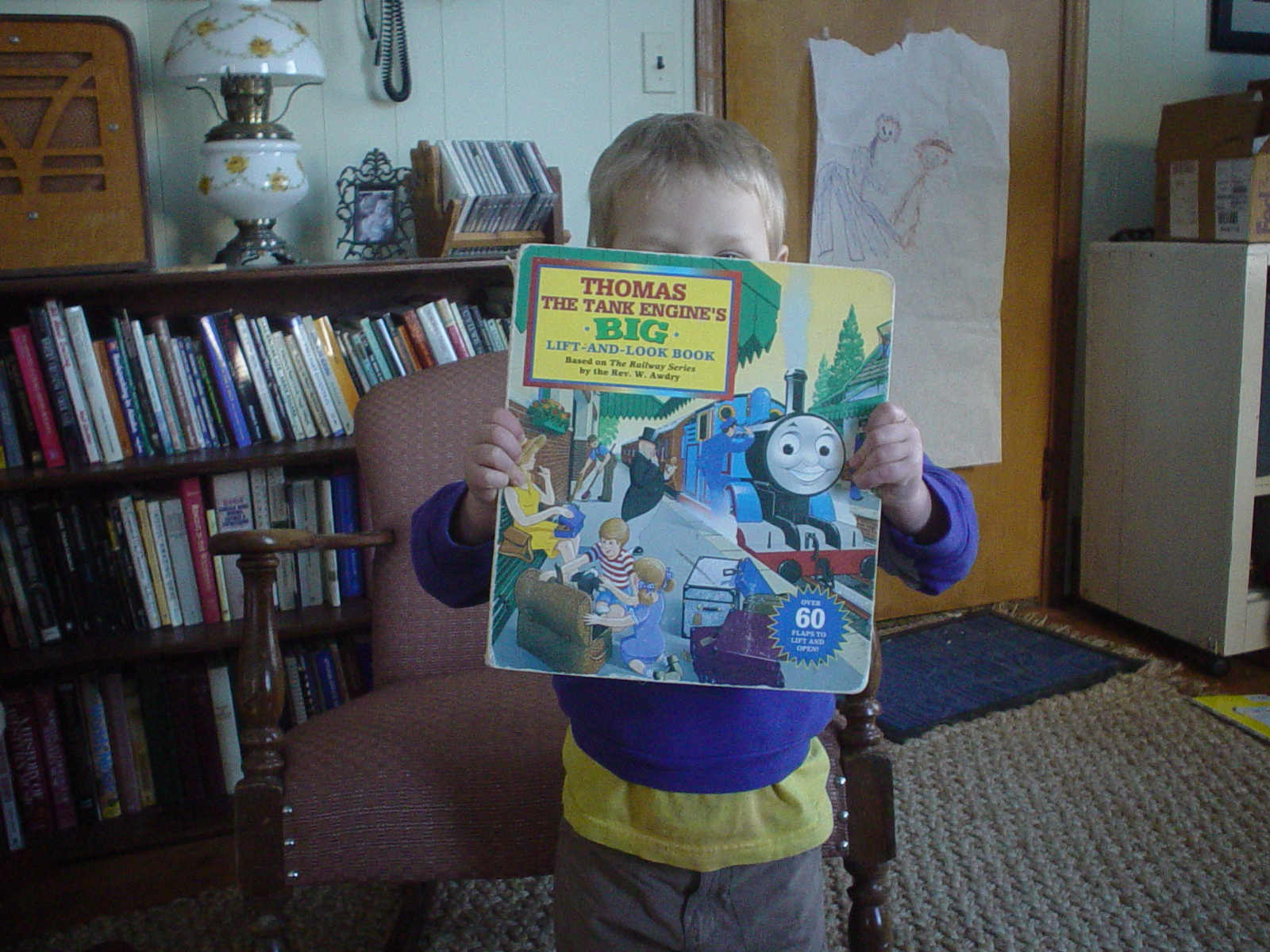
In February, the actual scene might look more like this: I am in a rocking chair, holding a book. It is not Plato’s Republic, but Thomas the Tank Engine’s Big Lift and Look Book. One child is on my lap because he was biting his sister at bedtime. The other is screaming that she is scared to be alone in her room. My drink of choice is Kahlua and cream, but I already drank it all. I didn’t bother putting the chocolate and ginger in a dish, but just ate them out of the bag while standing in front of the kitchen cupboard, keeping my back strategically turned towards the always-underfoot children. Dirty dishes are piled around the sink, and my husband is folding laundry on the couch. It’s looking like tomorrow’s dinner will once again be baked potatoes and carrot sticks. But at least I’ve got those jars of tasty ketchup that I canned in the summer.

For years now, I have regretted that Christmas is celebrated so early in the winter. Couldn’t people have waited until winter got good and nasty to have a big celebration? In December, even here in Minnesota, we can never be sure if we will even have snow for Christmas. In February, it’s a sure thing. In February, I am hungry for something to celebrate. I have become half-bear, convinced that hibernation would solve all my troubles. I, who love to get out of bed and go for a run at 5:00 on summer mornings, can hardly roll over by 8:00 on February mornings. I feel sleepy, swollen, and stupid; weary of the piles of clothes from which I must exhume myself every night for bed, weary of shoveling snow, weary of refereeing the ridiculous arguments and murderous brawls my small children have made their full-time occupation.

I know, the Christmas celebration lines up with the winter solstice, celebrating the return of the sun and longer days. And I do feel a glint of joy in February when I notice it is 5:00 and the sun is still shining. But, oh, how lovely it would be in February to saturate the house with the crooning of Nat King Cole, bake up a passel of Christmas cookies, fill up the calendar with parties and . . . the kids’ room with newly opened presents . . . and . . . hey, wait a minute, that sounds exhausting.

Skip it. The afternoon winter sun is radiating through the window, and I can just sit here and let it warm me, with no mental stress over cookies I’m not baking, parties I’m not planning, or even weeds I’m not pulling or gorgeous summer day I’m not taking full advantage of. I’ll bet there will be brilliant stars out tonight, with moonlight glowing over the snow. Alright, February, I surrender.

Wrestling With Why

Researchers tell us that most humans only use 5-10% of their brain capacity. As I watch my small children, I am convinced that they are using much more than that. They are always busy creating, discovering, exploring, trying something new. I, however, find it easy to believe that I’m only using a tiny fraction of my brain capacity. I have to work hard at creating, learning, trying new things. It’s no longer my natural inclination. To my children, it seems effortless.

I spent much of last year gorging on the writings of Madeleine L’Engle, a noted author whose “children’s novels” are plenty good reading for this adult. While pondering the generation gap and the sometimes-rebellious behavior of adolescents, L’Engle wrote in her reflective book A Circle of Quiet, “. . . the challenge I face with children is the redemption of adulthood. We must make it evident that maturity is the fulfillment of childhood and adolescence, not a diminishing; that it is an affirmation of life, not a denial; that it is entering fully into our essential selves.”

Hmm. Is it possible that children’s natural inclination towards discovery and creative thinking is something that should be encouraged, developed to even greater heights as they move into adulthood? Is it possible that the rebelliousness we’ve come to expect from adolescents mainly exists because the adult world for which we are preparing them is seriously flawed, because this world commands them to give up the seed of life and joy with which all children are born? Do we ask them to stop feeding the very thing that many of us go seeking in our midlife crises?

Currently I’m reading True Believers Don’t Ask Why by John Fischer, which I found on a ‘free books’ table at a local church that was cleaning out their library. Fischer’s book was published in 1989, but applies all too well today. Fischer, a singer and writer of the 1960s Jesus movement, wrote in this book that the youth of the 1980s were disappointingly less radical than he, a then middle-aged man, was.

Fischer wrote that this generation was much more interested in answering “how-to” questions rather than “why” ones. “How-to” questions are easily answered by the appropriate specialist. Answering “how-to” questions ensures success in an endeavor, and assumes that the answer is out there, fully obtainable if one knows who to ask.

“Why” questions, however, rarely have concrete answers. The same “why” questions have been asked and explored over and over again through the millennia of human history. Those who have wrestled with them have soared and suffered, produced brilliant work and been driven to madness – but have rarely remained the same after the struggle as they were before.

A person or generation who never asks “why” questions loses a sense of wonder, lacks the wisdom that the world, life, faith, everything true, is bigger than words, cannot be contained in a concrete answer. This person or generation lives superficially, fearful of new ideas and different perspectives, using not more than 5-10% of their brain power to explore the world around and within them.

So here’s to the askers of “why,” including my own especially fervent questioners Luthien and Silas. May the life I live encourage their continuing quests. May each of us grown-ups be a little more courageous this week in facing the “why” questions we’ve all-too-successfully grown out of asking.

“Our Need for Everything . . . “

This morning I am reading Saving Paradise: How Christianity Traded Love of This World for Crucifixion and Empire (Rita Nakashima Brock and Rebecca Parker) and came across these words quoting Ephrem the Syrian (c. 306-373):

“The inhabitants of the world fill in the common need from the common excess. We should rejoice in this need on that part of us all . . . Our need for everything binds us with a love for everything.”

I’m thinking today of the World Vision Christmas catalog that my young daughter Luthien and I were paging through a few days ago. You could buy medicine for sick children, food for hungry ones, animals to provide a livelihood for destitute families – and while the pictures were vibrant with joy and my daughter was enthusiastically deciding what she wanted to give, I found myself crying as page after page lengthened the list of needs. There is no way our family can give enough to meet all those needs.

But what a preposterous idea! Our family is one small piece of this circle of love and need. How often I forget, in this individualistic culture, that no one person or family or group is charged with saving the world. Neither is anyone only needy or only loaded with gifts for others. We are all of us needy, and we can each give something – a smile, a well-spoken word, a sum of money, a box of food, an hour of our time – as we affirm the life, the need, the beauty, love, and pain that make up the reality of the world in which we live.

May we all be courageous enough to live more faithfully within this circle of need and love, of vulnerability and generosity.