Ain’t That Grand

An ode to globalization, selfies and Jesus junk. I wrote this song shortly after reading The Story of Stuff, in which author Annie Leonard traces the stories behind the everyday stuff we westerners build so much of our lives around.

The song focuses on the people around the world who work, often for short pay and long hours, sometimes in slavery, often in generally poor conditions, to make the stuff that I think is so vital to my quality of life. In making the film to accompany the song, I chose to take a good hard look at my own face rather than further exploiting the beautiful and tragic faces of those who suffer just so I can save time and money perpetuating my comfortable lifestyle.

This video’s purpose is not to inform, inspire, call to action, or entertain. It is mostly to confess, lament, own up to the truth – that my perfect little plastic world is built on the backs of a good part of the real world.

I will not be swearing off my iPhone, my imported grapes, my sweat-shop-produced clothing. But I will be honest about the stories behind the things I allow into my life. There are many perspectives on globalization and the good or evil that it does to people and the planet. There are not easy answers. But this is something worth talking about, acknowledging, wrestling with.

A great place to get started is Leonard’s book, which, along with lots of other resources including some cute little films (whose purpose actually is to inform, inspire, call to action, and entertain), can be found at www.storyofstuff.org.

A couple other links:

About people (including children) mining for cell phone parts in Congo – http://www.congocalling.org

A fair-trade cell phone I just came across today (I know nothing about it, but looks like something worth checking out, *note – only available in Europe) – http://www.fairphone.com

A post I wrote on our less-updated blog golopomo about the environmental impact of our stuff – http://golopomo.wordpress.com/2010/08/19/humanature/

Electronic waste (e-waste) – http://en.wikipedia.org/wiki/Electronic_waste

Swallowed Whole by the Internet

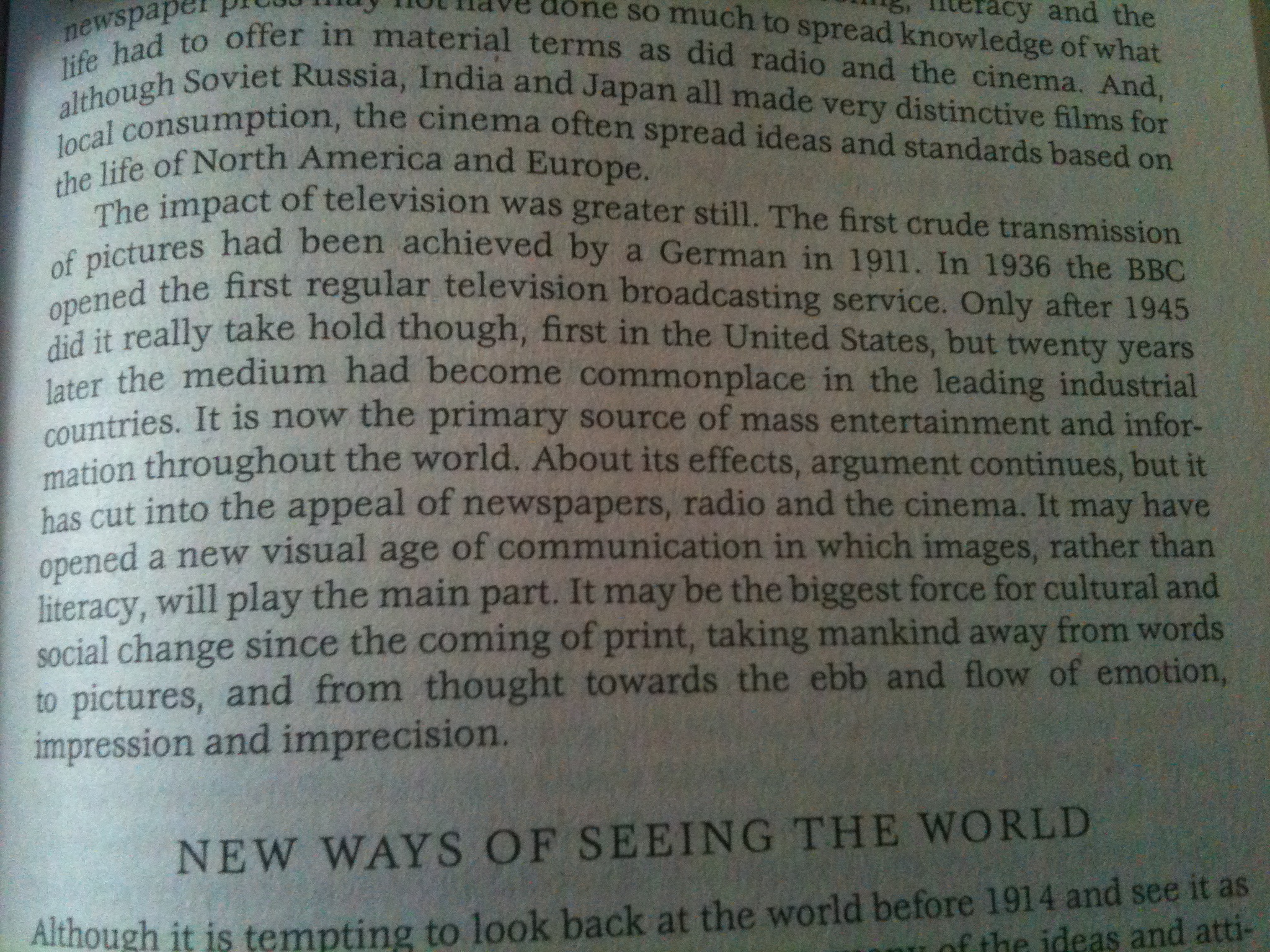
Short History passage

From A Short History of the World by J.M. Roberts, published 1993 by Oxford University Press.

The above words were published in 1993, only a couple years before the Internet began to catch on (I remember starting to use e-mail around 1995). I find them fascinating. If you start reading at “It is now the primary source of mass entertainment and information throughout the world . . .” and continue through the end of the paragraph, you could just as easily now say all of this about the Internet. But this author was writing about television.

Marking 1936 as the dawn of television as we know it, I wonder if this prophesied “biggest force for cultural and social change since the coming of print” will even last 100 years.  And then I wonder about the world-wide-web in comparison. Is this another “big new thing” that turns out to have a human-sized life-span? Or is it truly as much of a game-changer as the printing press (or more)?

Television’s days now look to be numbered, and even the printing press doesn’t run like it used to. The Internet incorporates both images and words. Images do seem to play a larger role in our general discourse than they did before the days of television, and I see no sign of that changing through our Internet use. But words continue to coexist with images, and if anything, it might be argued that the apparent triumph of Internet over television is evidence that words continue to be valued along with pictures. We want to be able to talk about what we are seeing.

The connectivity and interactive nature of the Internet certainly make it a more powerful and pervasive force than television ever was. And in actuality, rather than competing or usurping, the Internet seems to be simply swallowing and reconstituting television – along with radio, newspapers, the telephone, the personal letter, the community bulletin board, the music industry, maybe even the printing press.

What do you think?

Is the Internet here to stay?

Is our culture driven more by pictures or by words, and has the Internet changed anything about that?

Does the prevalence of the Internet over television signify a more thoughtful culture, or have we grown even less intelligent and more entrenched in our points of view than we were when we only had TV? (Now we have way more information available to us, but we can more easily find people and perspectives that reinforce our own static thinking. In the glory days of television, information and ideas were much more limited but, ironically, we were more likely to be exposed to people and ideas we might disagree with. True? Or not exactly?)

Has anything actually been swallowed whole by the Internet? Or will anything be? Or will we always have, operating apart from the world-wide-web, things like radio, newspaper, television, etc.?

And is that an image at the top of this post or is it words?

“Yes, Jesus Hates You”

I found this excerpt from Jeff Chu’s book Does Jesus Really Love Me?: A Gay Christian’s Pilgrimage in Search of God in America on Salon today, and wanted to share it here. It’s a longish read but he’s a great writer with a kind and thoughtful tone, just perfect for an attentive read with a hot cuppa close at hand.

Yes, there are Westboro Baptist types in the world. But the fact that they make it into the news so often, along with all the rest of the bad news that makes headlines, should ultimately give us hope. Because we take for granted that most people are not so blatantly hateful. We take this for granted because it is true. (I’m paraphrasing something Thupten Jinpa said in this recent On Being podcast which I also recommend.)

I Deleted The Doctor

Oh no, not That Doctor.

And not my friendly family practitioner.

The doctor I deleted was a knockoff of Doctor Mario – a free game I downloaded on my iPhone maybe a month ago, one snowy cold Minnesota Sunday when I thought, hey, I wonder if there are any Doctor Mario games I can download for free on my newly acquired iPhone 3gs? (Doctor Mario was my favorite video game back in my college days – it’s something like Tetris.)

And sure enough, there was one.

Thus began my addiction.

I played it to “de-stress.” I played it on Sundays, while the rest of the family played Xbox. I played it in the evenings after the kids went to bed. I played it in the evenings while dinner was cooking. I played it in the evenings after dinner while the kids did their clean-up chores. I played it on Saturdays. I played it while the kids would ask me if I wanted to play with them. Usually I’d put it down then, but not always.

These are the confessions of an addict.

I knew I needed to quit. Heck, I knew I should never have started. When Nathan inherited and fixed a broken Xbox and asked me about my interest level, I said, don’t get me started. I hadn’t played a video game in years, and for good reason. I get addicted.

This past weekend I went on personal retreat. Of course I had my phone with me. No, I did not play – or even feel tempted to play – “my game” during the whole weekend (I would have drained the battery and there was no electricity in my hermitage!). I read some books that renewed my inspiration to live generously, slowly, meaningfully (The Windows of Brimnes by Bill Holm, Man’s Search for Meaning by Viktor Frankl, and Everything Must Change by Brian McLaren).

I came home truly de-stressed, and eager to live more intentionally, more present to the people around me in each moment.

And I succeeded, for maybe ten minutes! I hugged my family, played a card game with a friend’s daughter who was visiting; and then when the kids went in the other room to play some Xbox together, I went for my fix with the Doctor.

It was my last fix, though. That evening as I reflected over the day, remembering my kids seeing me pull out my phone and saying, “oh, you’re playing your game again aren’t you?” – and not in a joyous, “good-for-you” tone – I decided to delete the Doctor.

Clicking that little “x” felt great.

Now I’ve decided that a “de-stressing” activity should be something that is ultimately good for me – like exercise, or good food, a conversation with a friend, playing music, taking a power nap or curling up with a good book, catching up on the blogs I follow, or even watching an episode of The Doctor – the one I would never delete!

I know, I can always download the other Doctor again. But I’ll have myself, my family, and the expansive life of my dreams to answer to.

“Belief Without Compassion”

Jonathan Fields posted this wonderful piece – “Belief Without Compassion” – yesterday. In our hyper-polarized society, his words are deeply significant – especially related to religion and politics.

In my experience, the most intolerant, un-compassionate people generally fall into two groups: those who haven’t changed their minds about anything in years, and those who have just recently changed their thinking on some major issue, and expect that suddenly everyone else should have the same eureka moment they just experienced.

But the more we think about anything in conversation with the world beyond ourselves, the more we grow our capacity for compassion. Even while being better able to articulate our own beliefs and perspectives on any particular topic.