Thirty Nine – A Listener’s Guide

It was my 39th birthday yesterday. And I’m giving you a gift. A free record called Thirty Nine, a sort of faith and doubt memoir told through music.
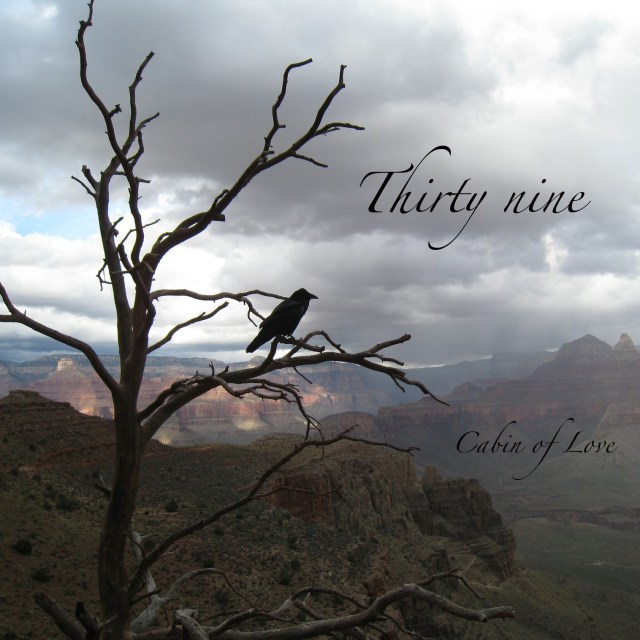
Thirtynine

I imagine these songs to be a sort of conversation, possibly going on in my head, possibly with God (and I think these two ideas are not mutually exclusive).

Here are some virtual liner notes, a little listener’s guide if you like:

“Bridges for Burning” – Some things, we lived through once, and that was plenty, and we can let go of them now. Others are worth holding like treasure, deep in the heart.

“From Your Love” – The euphoria and unshakeable confidence of a young fresh believer. Mostly quoting Paul, from his epistle to the Romans, chapter eight.

“So Good” – More euphoria, gratefulness, love.

“So Easy” – I begin to question myself. Really? Naive little girl, have you given any of this much thought?

“Ask” – Little girl begins to grow up, starts to voice questions that have grown bigger over the years she’s been squelching them.

“Epiphany” – God, never threatened by questions, always seeing to the heart of the matter, sings a not-exactly-soothing lullaby.

“Come Out and Play” – I wonder about this faith, hope and love I’ve staked my life on until now. And even if there is a lover of my soul, am I interested?

“Come Unto Me” – And still, God asks, invites, apparently also unthreatened by the possibility of public rejection and humiliation.

“Demystification” – Enough with the mystery and romance. I demand of God, explain yourself. Just show up.

“89 Degrees” – My world is burned, my heart is drowned. I’m about to turn the corner. Are you still there?

“Dreaming for You” – God sings – I have a dream, and it’s for you. (And I liked the way you started that last song so I’m doing a variation on it.)

“Farewell Fairytale” – I get the last word. Also the first, of the rest of my life. I burn some bridges, and walk on, in the wild wandering Way.


Thirty-Nine

I couldn’t sleep last night. Nathan and I are getting ready to release a new full-length album, one we’ve been working on for, oh, five years or so, and the title we chose for it is Thirty-Nine. The songs are records and reflections from my personal journey through faith and doubt, and our working title was “FaithedOut” or “Faith-Doubt” or – well, we couldn’t figure out how to spell it to make it work without being spoken, mute on an album cover. Faith and doubt, but also faithed out, as in worn out, churched out.

I’m turning thirty-nine this year, this month actually, and we decided, when the guy we hired to master the album asked us for the title last week, to call it Thirty-Nine, partly because of my age, partly because 1939 was a dark time in history (the Great Depression in the United States, Germany invades Poland and begins the second world war), and mainly because of the not-quite-fortiness of it, the almost-there-but-still-slogging feeling of thirty-nine, no milestone, just faded-ness. 

That was all rolling around in my head last night, and I knew I wouldn’t sleep until I wrote something and put it to rest. Below is what I wrote. Most of my thirty-nine years have not felt like this, of course, but a considerable portion of my recent years have come closer to a “dark night of the soul.” I share this mostly to introduce some of the sentiment behind our new album title. Yeah, it’s really my wordy and hype-aversive way of starting a “launch” for the new album – coming to you (for free through Noisetrade!) on October 26th.

Thirty-nine is an unholy number. Noah waited forty days and forty nights in the ark while it rained and everything outside drowned. Moses spent forty years in the desert, and only then began his long journey leading Israel to the promised land. Jesus fasted forty days in the wilderness before he started his three years of work that changed the world.

On the thirty-ninth day, in the thirty-ninth year, nothing happened. In the wilderness, in the womb-like tomb-like ark, it was only one more of a long string of the same – wandering, hungry, lonely, in the land of unknowing, a heart forsaking and forsaken.

It’s the second-to-last year, or day, of the long dark nothing. I’ve been keeping count, and I know it, but another year, another wasteland of a day, awaits me after this one. Even as hope begins to germinate. Forty is the pattern I know from my thirty-nine-year history reading Bible stories. I know that after forty has passed, something new begins.

So in the dark, on yet another impenetrable night in year thirty-nine, I feel tiny cracks in my heart. Something new pushing inside. An olive branch and a rainbow, a burning bush, food, water and comforting angels might be in store, on the path up ahead.

The dark still whispers fears in my ears, still tries to dress me down, show me wrinkles and withering and death to all things. But I’m nearly thirty-nine now. I’ve nearly made my peace with the dark, count her among my acquaintances now, need not run.

This next year will be bittersweet. And then, who knows? Who knows?

There now, dark. There, I’ve written it, or something like it, or something anyway. Now may I sleep?

“That Dreadful Question ‘What For?'”

This right here. After 38.5 years of living and on my 16th wedding anniversary (happy day, Lover!), I deeply resonate with Seth Godin’s post about the infinite game.

What is the meaning of life? Godin answers it – “To play.” In Christian religious speak (and archaic sexist language), the question and the answer go like this – “What is the chief end of man? Man’s chief end is to glorify God and to enjoy him forever.”

In Tolstoy’s War and Peace (which took me the past year to read!), Pierre – a Russian aristocrat taken captive by the French – discovered the same thing after being freed.

(Aw, go ahead, sit down and read this little passage! I’ve highlighted my favorite parts for you skimmers, and added a couple explanatory notes in brackets. And I acknowledge that this passage also uses sexist language.)

A joyous feeling of freedom- that complete inalienable freedom natural to man which he had first experienced at the first halt outside Moscow- filled Pierre’s soul during his convalescence. He was surprised to find that this inner freedom, which was independent of external conditions, now had as it were an additional setting of external liberty. He was alone in a strange town, without acquaintances. No one demanded anything of him or sent him anywhere. He had all he wanted: the thought of his wife which had been a continual torment to him was no longer there, since she was no more [it hadn’t been a happy marriage, and his wife had died while he was in captivity].

“Oh, how good! How splendid!” said he to himself when a cleanly laid table was moved up to him with savory beef tea, or when he lay down for the night on a soft clean bed, or when he remembered that the French had gone and that his wife was no more. “Oh, how good, how splendid!”

And by old habit he asked himself the question: “Well, and what then? What am I going to do?” And he immediately gave himself the answer: “Well, I shall live. Ah, how splendid!”

The very question that had formerly tormented him, the thing he had continually sought to find- the aim of life- no longer existed for him now. That search for the aim of life had not merely disappeared temporarily- he felt that it no longer existed for him and could not present itself again. And this very absence of an aim gave him the complete, joyous sense of freedom which constituted his happiness at this time.

He could not see an aim, for he now had faith- not faith in any kind of rule, or words, or ideas, but faith in an ever-living, ever-manifest God. Formerly he had sought Him in aims he set himself. That search for an aim had been simply a search for God, and suddenly in his captivity he had learned not by words or reasoning but by direct feeling what his nurse had told him long ago: that God is here and everywhere. In his captivity he had learned that in Karataev [a peasant who had befriended Pierre in his captivity] God was greater, more infinite and unfathomable than in the Architect of the Universe recognized by the Freemasons. He felt like a man who after straining his eyes to see into the far distance finds what he sought at his very feet. All his life he had looked over the heads of the men around him, when he should have merely looked in front of him without straining his eyes.

In the past he had never been able to find that great inscrutable infinite something. He had only felt that it must exist somewhere and had looked for it. In everything near and comprehensible he had only what was limited, petty, commonplace, and senseless. He had equipped himself with a mental telescope and looked into remote space, where petty worldliness hiding itself in misty distance had seemed to him great and infinite merely because it was not clearly seen. And such had European life, politics, Freemasonry, philosophy, and philanthropy seemed to him. But even then, at moments of weakness as he had accounted them, his mind had penetrated to those distances and he had there seen the same pettiness, worldliness, and senselessness. Now, however, he had learned to see the great, eternal, and infinite in everything, and therefore- to see it and enjoy its contemplation- he naturally threw away the telescope through which he had till now gazed over men’s heads, and gladly regarded the ever-changing, eternally great, unfathomable, and infinite life around him. And the closer he looked the more tranquil and happy he became. That dreadful question, “What for?” which had formerly destroyed all his mental edifices, no longer existed for him. To that question, “What for?” a simple answer was now always ready in his soul: “Because there is a God, that God without whose will not one hair falls from a man’s head.”

Taking Everything Slow

“Why do we always lose our childlike faith/ the moment we attain our childhood dream?” A song about aging, moving west, failure that heals and progress that kills. And some other stuff I’m not sure about . . .


Take this song and shove it if you want to

Take this tune and turn it out of doors

These words are just a caffeinated frenzy

Scribbled on the napkin of your soul


I used to be a ballerina poet

Dancing through a rainbow-colored world

Now I dig for water in the desert

Jump for joy each time the thunder rolls


Oooh, I’m taking everything slow.

Oooh, how slow, how low can I go?


I rode out west to chase the infinite sunset

To swallow ghost towns whole inside my heart

To lose my old religion in the canyons

But morning always catches up with me


Oooh, I’m taking everything slow.

Oooh, how slow, how low can I go?


Hold that thought close to your unblinking mind

Watch how it withers right there on the vine


They’re taking applications for a mystery

They’re ticking off a transcendental(bucket)(l)ist

With wrecking balls and shopping malls to heal us

And freeways to escape our burned-out past


Remember when you couldn’t wait to grow up

To live your life exactly as you pleased?

Why do we always lose our childlike faith

The moment we attain our childhood dream?


Oooh, I’m taking everything slow.

Oooh, how slow, how low can I go?