Reverie

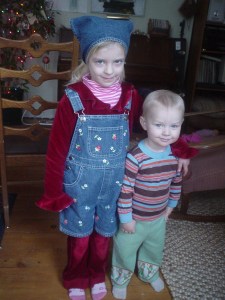
I’d like to take a snapshot of my four-year-old son right now, but I’ve decided against it. I don’t want to interrupt his reverie.

He is playing the piano. Not banging on it, but playing it. A note here, a note there, a little pattern, which he will repeat if he likes it. Even some simultaneous notes now and then to make a pleasant-sounding chord. His older sister’s piano book is on the music stand, and he is paging through it, looking at it as he thoughtfully presses keys.

The parent voice told me to get over there and show him a thing or two – “look, Silas, this is middle C! Can you play middle C?”

Then the artist voice in me said, “easy, sister, let him explore. Let him lose himself in the moment, let him float on the music he is making!”

Then the parent voice said, “oh yes, good thought. But I should at least get this on video.”

And the artist and the mother together decided, “Nope. No video. The camera would distract him. Let him be. Go type this out on your blog and let him be.”

And so he is alone in his reverie, which is probably the best way for him to start his friendship with the piano. I suppose that “reverie” shares a root with “reverence,” and that is how this moment feels.

The Good, the Bad, and the Younglings

Danny DeVito made a movie in 1996 called Matilda, based on a book of the same name by Roald Dahl. A copy of this movie wound up in the bargain bin at a local video store, where my mother was browsing for something to entertain her grandkids so we adults could spend an evening in conversation which included complete sentences. My six-year-old daughter Luthien told me later about the movie and how much she liked it. Her favorite parts, which she described repeatedly, sounded lame to my adult sensibilities.

Typical kids’ story, I thought. Poor little child misunderstood by her parents (at least not orphaned like so much of children’s literature). People are either mean or nice, and she has some sort of magical powers to help her through her ordeals.

A week later when we took the kids to my parents’ house for a movie night, and Luthien asked to see Matilda again, I groaned and asked if we could please see something everyone would enjoy, not just the kids. But, poor misunderstood-by-my-parents me*, I was outvoted. On with the show.

Maybe it helped to have my enthusiastic fresh-faced daughter at my side, and her excessively giggly little brother primed to let loose at all the silly parts. I’m sure Danny DeVito and Rhea Perlman playing the outlandish parents helped too. Whatever it was, it turned out to be a fun movie to watch together with my kids. I gave my grown-up critic the night off and joined with my kids in relieved laughter when the victorious school children chased away their mean principal once and for all, hurling the contents of their lunch bags like a G-rated mob.

Later, when the grown-up critic came back from her night out and the kids were asleep, Nathan and I had a conversation (which included complete sentences).

“That movie bothered me,” Nathan began. “All those flat characters – the perfectly mean principal, the perfectly good teacher, named Miss Honey even?! Where’s the redemptive value in a story like that?”

Both of us having only in adulthood discovered subtlety (I love Jodi’s post about this), Nathan and I appreciate stories that humanize people. We remind ourselves and our children almost daily that there are no “bad” people and no “good” people – that every person is a complex being marbled with good and evil.

Classic children’s literature, however, does not often concur. Many of these stories tell about good people (who are usually underdogs and often children) winning by destroying bad people. We see it often in today’s movies for kids too. Up, which was a fun story idea and colorful and interesting to watch, disappointed us for the same reason. The bad guy, apparently, had to go.

Not all children’s stories conform to this standard, but in those that take the conflict of good versus evil as their theme, good and evil are often personified and therefore become polarized characters. Therefore the good character must destroy the bad character for good to triumph over evil. In a more complex story, the good character may do bad things (like Edmund in the Narnia chronicles), but ultimately that character will exhibit his/her inherent goodness through repentance. If there is character development, it will most likely be the good characters who get developed, and not the bad.

At least, that is the explanation I came up with when Nathan and I had this conversation and I tried to understand why children’s stories are not often redemptive.

No expert on childhood psychology (of which, as the parent of small children, I am more painfully aware than ever), I’m pretty sure I’ve heard somewhere that children are concrete thinkers; and I think this means that subtlety just isn’t something they get. So, maybe these stories help to cement into their concrete thinking the persistent human belief that no matter the odds, good will overcome evil in the end.

And maybe subtlety is something to be gained through maturity, interacting with the world, listening and observing others. Maybe the understanding that every person – and every situation – is complex and has something beautiful as well as something ugly or dangerous or evil in it can only come through experience, cannot be transferred through external teaching.

Taking this viewpoint, I think that Avatar should be classified as a children’s story (a highly interesting, predictably violent and visually stunning one) while Star Wars is for mature viewers.

Then again, even in Star Wars, the bad guy known as the Emperor never gets redemption. And maybe Darth Vader would just be classified as a good guy doing excessively bad things for an excessive amount of time until he repents and gets to be immortalized as good.

I dunno. It just feels deeply right and true to me when, as the Doctor triumphantly said in one of my favorite Doctor Who episodes, “Just this once, everybody lives!”

*Uh, Mom . . . Dad . . . my tongue is firmly in my cheek here. (Can’t afford to lose my biggest fans!)

In Twenty Years

I attended my friend Victoria Peterson-Hilleque’s poetry reading last night. She, along with her colleagues Sarah, Andrea, Didi, and Jill shared poems from the manuscripts they created for completion of the Master of Fine Arts degree in creative writing at Hamline University. I enjoyed all the poets’ works, and am especially honored to know Victoria and excited for her accomplishment!

Inspired by these writers, I am posting a poem, and purpose to do so more often.

In Twenty Years

© 3/10/2010 Julia Tindall Bloom

In twenty years, maybe less,

These are the things I will wistfully remember:

A small black shoe

A downy white feather

A wide red ribbon

Two silvery little ice skates

A garish plastic necklace

A child-sized guitar

A shoebox-sized pick-up truck

Seashells

Rocks

Tiny socks

And a young artist’s scattered portfolio

All these in random places and positions

Throughout my living space

Offending my orderly sensibilities

But alive with the news

Of the burgeoning existences

Of Luthien and Silas.

Wrestling With Why

Researchers tell us that most humans only use 5-10% of their brain capacity. As I watch my small children, I am convinced that they are using much more than that. They are always busy creating, discovering, exploring, trying something new. I, however, find it easy to believe that I’m only using a tiny fraction of my brain capacity. I have to work hard at creating, learning, trying new things. It’s no longer my natural inclination. To my children, it seems effortless.

I spent much of last year gorging on the writings of Madeleine L’Engle, a noted author whose “children’s novels” are plenty good reading for this adult. While pondering the generation gap and the sometimes-rebellious behavior of adolescents, L’Engle wrote in her reflective book A Circle of Quiet, “. . . the challenge I face with children is the redemption of adulthood. We must make it evident that maturity is the fulfillment of childhood and adolescence, not a diminishing; that it is an affirmation of life, not a denial; that it is entering fully into our essential selves.”

Hmm. Is it possible that children’s natural inclination towards discovery and creative thinking is something that should be encouraged, developed to even greater heights as they move into adulthood? Is it possible that the rebelliousness we’ve come to expect from adolescents mainly exists because the adult world for which we are preparing them is seriously flawed, because this world commands them to give up the seed of life and joy with which all children are born? Do we ask them to stop feeding the very thing that many of us go seeking in our midlife crises?

Currently I’m reading True Believers Don’t Ask Why by John Fischer, which I found on a ‘free books’ table at a local church that was cleaning out their library. Fischer’s book was published in 1989, but applies all too well today. Fischer, a singer and writer of the 1960s Jesus movement, wrote in this book that the youth of the 1980s were disappointingly less radical than he, a then middle-aged man, was.

Fischer wrote that this generation was much more interested in answering “how-to” questions rather than “why” ones. “How-to” questions are easily answered by the appropriate specialist. Answering “how-to” questions ensures success in an endeavor, and assumes that the answer is out there, fully obtainable if one knows who to ask.

“Why” questions, however, rarely have concrete answers. The same “why” questions have been asked and explored over and over again through the millennia of human history. Those who have wrestled with them have soared and suffered, produced brilliant work and been driven to madness – but have rarely remained the same after the struggle as they were before.

A person or generation who never asks “why” questions loses a sense of wonder, lacks the wisdom that the world, life, faith, everything true, is bigger than words, cannot be contained in a concrete answer. This person or generation lives superficially, fearful of new ideas and different perspectives, using not more than 5-10% of their brain power to explore the world around and within them.

So here’s to the askers of “why,” including my own especially fervent questioners Luthien and Silas. May the life I live encourage their continuing quests. May each of us grown-ups be a little more courageous this week in facing the “why” questions we’ve all-too-successfully grown out of asking.

Reaching Maturity, or, If I Were a Tomato

On Monday evening my proud papa showed my youngsters video clips he had taken of me and my band almost ten years ago. There we are, up on the big stage, under the bright lights, playing our twenty-something hearts out. “We were young and we were improvin’. . .”

the glory days for rock band St. Andrew's Descent

the glory days for rock band St. Andrew’s Descent

Mellencamp was on to something, although I haven’t always thought so over the years. Wrinkles, gray hairs, extra pounds and stretch marks don’t seem like an improvement. But they are simply markers of the real life I’ve been living. The wrinkles around my eyes record the smiles and laughs that have crinkled the skin there again and again. The creases between my eyebrows show the grip of stress, grief, and anger. The gray hairs grow from a head that has pumped out thoughts and dreams at the pace of a Chinese toy factory. The poochy tummy and the stretch marks tell about the two people I co-created, nourished, carried and bore into the world.

These days I don’t look back as wistfully as I used to. I can almost laugh at – I mean with – no, I mean at – the profoundly serious girl up there on the stage, who scans every audience for a talent scout and will soon cry herself to sleep the night she learns of her first pregnancy, certain this means death to her creative life.

Small children, it turns out, are small for only two or three blinks of an eye. This is a great relief and an eternal sadness.

yes, they dress themselves!

yes, they dress themselves!

They are also loaded with material – not only the fecal variety, but the sort of material every writer seeks – magical moments, ironic situations, hilarious word usage, and heart-stabbing lovelinesses and tragedies of all sorts.

On Tuesday morning I took my guitar down from the wall and began to play and sing. My two-year-old Silas hurried from the other room, smiling and dancing like sun-sparkles on a forest stream. It was a stellar performance. I totally connected with the audience. I’m pretty sure I’ll get another call soon (“Mommy! Play my song again!”).

Lately I’ve discovered that the songs and performances I do create, when I take the time, are better than those of ten years ago, and they often take less effort. I think this is about reaching maturity.

This past spring I bundled up and went out to the garage, where I poked tiny tomato seeds into small pots of soil arranged on an old cookie sheet. I brought the cookie sheet into the house and set it on top of the refrigerator so the seeds could stay warm and germinate.  It took about a week before I saw more than soil in those pots. It took even longer for the tiny seedlings to grow into recognizable tomato plants that could stay outside overnight alone.

Once I finally got the plants outside, the tender leaves soaked up sunlight and used that energy to make more leaves, which all soaked up more sunlight and made more leaves, so that the plants grew exponentially. A couple weeks ago, green tomatoes began blushing into red, and I knew that the plants were doing what the seed packet had said they would do in the prescribed number of days – reaching maturity. Now every day I spot another brilliant red tomato, standing out vividly from the surrounding green leaves.

If I were a tomato plant, I think I would currently be putting out yellow blossoms. These blossoms are more interesting than the green leaves I have spent much of my life to produce, but it gets even better! If I keep growing, one day I will make brilliant red fruit with the power to nourish and cheer whoever finds it. I don’t miss those spindly seedling days. And I’m not seeking to preserve these yellow flowers. I’m going for the juicy red fruit. I’m reaching for maturity. I’m still young and still improving.