On Hearing of Shirley’s Death

Old people in Rhode Island are dying. This matters to me because I knew them once, and once they knew me. But only for a time. I moved to Rhode Island when I was nearly five years old, and moved away when I was not as nearly six. I can still see the sun-drenched wood in the sanctuary of the village church where my dad pastored. I can smell it too – it is living and aged and clean, and conscientiously polished.

Robin’s mother Carol died a few years ago. Carol had soft brown eyes and was always kind to me. Her fisherman husband, Wayne, has phoned my parents every few years since we moved away thirty years ago. Last time Wayne called, when my dad asked, “how are you?” Wayne said simply, “Carol died.” He explained more, but that was beside the point. Carol died, and that’s how Wayne is. All your life together, you know it’s coming, you just don’t know which one of you will be first. Then you get a hint or two – a sickness that lingers, an irreversible fading – and now you know it’s coming, you know she will be first, but you can’t pinpoint the day or the hour. You eat together (if she can eat), you sleep (lightly), you go about your business the best you can, and then one day, one hour, she dies. And that is how you are, when people ask.

Last week Sharon’s mother Shirley died. After all these years, her laugh is still stored in my memory. So is her face, open and sturdy, with an elegant yet practical pile of curls atop her head. I maybe knew this as a child and forgot, but now, as I remember Shirley, I note a deep likeness with Wayne, and upon asking my parents, confirm that they were siblings.

Carol and Shirley knew me for a few months of my childhood. I wonder what they remembered about me? And where do those memories go when they die?

When we grieve the death of someone we knew, however much or little we knew them, are we partially grieving the death of our own footprints in that life? I imagine I’ll be experiencing this more in these years ahead, as I lose those with whom I’ve formed deeper bonds – grandparents already, someday parents, maybe lover, surely friends. Will I feel the breadth of my life, my being known in the world, shrink? Will I look back and see my trail overgrown and forgotten?

Of course, that’s why we write. We surely can’t rely on people to keep our memories alive. They simply won’t stick around. So we write or tell our stories in other ways, and pass them on to our children and their children – and we hope that in some way who we were and what we did will really mean something after all.

Robin and Wayne, and Shirley’s family John and Sharon, Duane, Ariane and J.B., and the others I don’t know who belong to them too, are grieving far more than any vague loss of self. I know this, and I honor their tears and heartache.

But I won’t call my thimblefuls of grief at the losses of Carol and Shirley narcissistic, though at face value that’s just what they seem. A tiny something of me stayed with each of those women, and even as they and those little memories have now died, so too the tiny memories I have of them live on in me. Of course I’ll die too, but I find this giving and taking, living and dying, between people widely separated by age and geography, who physically interacted for only a few months of a long lifetime, to be a talisman of hope on my journey.
Maybe Not

Here is a new song, and the first one we’ve recorded as a video and posted on Youtube.

Lyrics –

Maybe Not
copyright 2010 Julia Bloom

My life is a movie edited for TV, seething under docile mediocrity, and if you paint pictures better take a good look, if you like stories this would make a good book. Or not, maybe not.

I grew up in the back seat of the family Ford. My daddy was a preacher traveling for the Lord. My momma smiled sweetly and dressed us up well. We labored in the vineyards keeping sinners out of hell. Or not, maybe not.

I’ve gazed at stars until they burned my eyes, drunk living water till my throat was dry.

I had a hundred crushes but I never caught one, I had a couple boyfriends and we had a little fun, I had a couple babies with the man who calls me wife. We’ve been together twenty years, we’re bonded now for life. Or not, maybe not.

Sometimes under my feet I think I feel the world spin round. Is each day going faster now or am I slowing down? Once when I was concentrating, unafraid to see, speeding past myself I saw a lively younger me. Or not, maybe not.

I’ve kissed the hand that held me in my place, I’ve wiped each wisp of wonder from my face.

Every time I think of getting something off my chest, my barricaded broken heart cries, “citizen’s arrest!” I never can remember why I left the womb. I maybe lost my keys, I’ll maybe find them in the tomb. Or not, maybe not.

I used to paint pictures when I was a little girl. I used to write stories that could echo round the world. The colors are all faded now, the pencil marks erased – those scribbles of my childhood were nothing but a waste. Or not, maybe not.

I’ve lain awake just waiting for a dream. I’ve held my tongue until I want to scream. I’ve kissed the hand that held me in my place. I’ve wiped each wisp of wonder from my face. I’ve gazed at stars until they burned my eyes, drunk living water till my throat was dry.

Or not. Maybe not. Or not, maybe not.

A God of Mythic Proportions

What if God really is a construct of the human mind, collective human consciousness, generations of human culture? Does that mean we’re not still on to something? Our stories about transcendence, our yearnings for immortality, for perfect love and world peace – are they really only wishful thinking, or could they be baby talk in a real language we hear but cannot comprehend or speak yet?

I suspect we the human race have never gotten it right in our attempts to fully describe it – and it’s possible we’ve not hit on anything remotely close yet to the reality of that being/force/substance/unimagineable I Am/none of these things.

Are we truly naive and destructive for reaching, seeking, asking, theorizing? Of course not, not for those things. But for insisting, grasping, lying (willfully), closing eyes to the observable truth, claiming superiority, excluding, and faking – therein lies religious humans’ ignorance and destructiveness.

I can’t think like I used to – or pray like I used to – can’t sing or talk or go to church or get into a Bible study – not like I used to – but I can’t let it go either. Is it embedded in my psyche because it’s what my ancestors did? Partly, I’m sure. I can never know what it would be like to encounter my faith tradition with the wisdom and discretion of an adult. I can’t completely separate personal nostalgia from the stories of my faith, can’t divorce the little-girl wonder and comforting taste of church potlucks, soft embracing arms of Sunday School teachers, smell of glue and construction paper, sound of rich organ strains, from the doctrine of the Trinity, the gospel of Jesus.

I also can’t completely filter out the shaming looks and words, the hateful tones used of people different from us, the arrogant proof-texting and the general dullness and deadness – the constricting sameness, the denial of humanity in its richness, brokenness and wildness – that hummed around me like the radio station always tuned in and played low.

No, all of that is there, mingled with the body and blood of Christ, between the lines of the King James Version Bible memory verses filed away in my brain.

But it breathes like a living thing in me. It does not lie there mutely like a sterile model under museum glass, oblivious to my scrutiny.

I respect my fellow humans who see no sign of God. Their ideas have given me courage to explore my own – to go down deeper, unafraid (well, less afraid) of people’s opinions of my excavations. I have been changed, and am being changed – I am plunged more into myself, more into humanity, more into life and truth and this shattered, shining world.

The God of my past looks increasingly like a puppet, stitched together from Bible stories, religious aspirations, moral intuition; and animated by power-hungry men. But somewhere in there, I feel so sure, is a beating heart.

Lately I’m letting go of the fairy tale god who came prefabricated for me, all outlined in the Christian school curriculum, and pursuing the living God who cannot be contained in anyone’s mind, or so the stories go. Maybe this God is only a myth in the not-real sense of myth, or maybe this God is deeper and weightier than anything I’ve experienced, which is why this God for now resides in myth.

I journey on, a pilgrim in search of God – and I think it will be a lifelong quest, which only underscores the worthiness of the One I seek.

In Twenty Years

I attended my friend Victoria Peterson-Hilleque’s poetry reading last night. She, along with her colleagues Sarah, Andrea, Didi, and Jill shared poems from the manuscripts they created for completion of the Master of Fine Arts degree in creative writing at Hamline University. I enjoyed all the poets’ works, and am especially honored to know Victoria and excited for her accomplishment!

Inspired by these writers, I am posting a poem, and purpose to do so more often.

In Twenty Years

© 3/10/2010 Julia Tindall Bloom

In twenty years, maybe less,

These are the things I will wistfully remember:

A small black shoe

A downy white feather

A wide red ribbon

Two silvery little ice skates

A garish plastic necklace

A child-sized guitar

A shoebox-sized pick-up truck

Seashells

Rocks

Tiny socks

And a young artist’s scattered portfolio

All these in random places and positions

Throughout my living space

Offending my orderly sensibilities

But alive with the news

Of the burgeoning existences

Of Luthien and Silas.

Pillsbury Presently Past

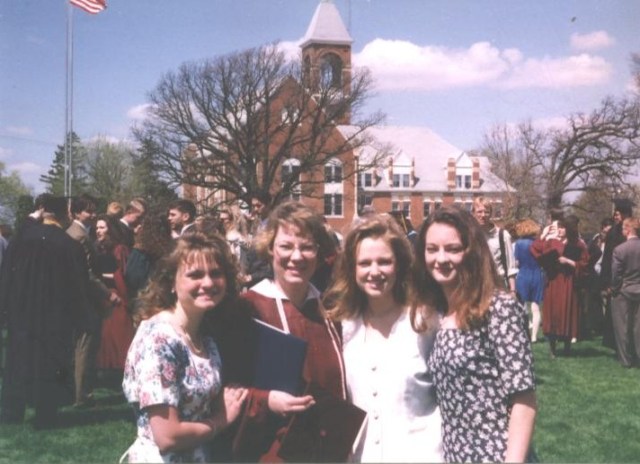
1995 Graduation Day at Pillsbury College

Amilee, my mom Becki, Ginger, and me in front of Old Main

This morning I ran past my old college, which was also my dad’s workplace during my junior high and high school years. It closed last year, and beside the sign that proudly bore its name for fifty years is another white one with red letters proclaiming, “For Sale.” My grieving process about this is complicated. Some days I feel like doing as Jenny did to her childhood house in Forrest Gump, and throwing rocks at the buildings. This morning I just felt melancholy, nostalgic, in the perfect mood to write a poem.

Pillsbury Presently Past
by Julia Tindall Bloom, June 13, 2009

come my college compatriots
let’s wander the sidewalks of our old campus
silent sidewalks, stretching sleepily
vaguely remembering the sound and motion
of glory days.

come my college classmates
let’s head to class
once-modern Pillsbury Hall
still smells, looks, feels like the seventies
i prefer the creaky floors
the cracked chalkboards
the clunky doors and windows
of ageless Old Main.

come my college teammates
let’s set up the volleyball net
in the machine-shed gym
it never looked like much
we never won much
but we got sweaty enough
the crowds were moved enough
we had our shining moments.

come my college roommate
time heals wounds
i wonder what it’s done to our old dorm room?
maybe not completely erased the canned-tuna odor
maybe a few sound waves from late-night talks
are still bouncing off those concrete blocks.

come my college sweetheart
let’s sit at that library table
where two child-adults fell in love
(dust is spreading there
over the remains of that flirtatious conversation)
then we could move to the stone bench by the flagpoles
where we fell out again
and gaze across the vacant campus
where we faded apart

years ago
a lone pianist in Kelly Hall
sent practice notes out the window
onto the breeze
some caught in branches of the old enormous trees
some floated up to Old Main’s bell tower
where they rest quietly now
along with the hollers and cheers of a hundred football games,
the ringing “Amens” of a thousand chapel services,
and every last whisper and sigh
breathed in this place.

rain still falls on these gracious lawns
water patiently drips from battered downspouts
life courses through this world
but not like it used to.